Civil Services Examination · Question 27
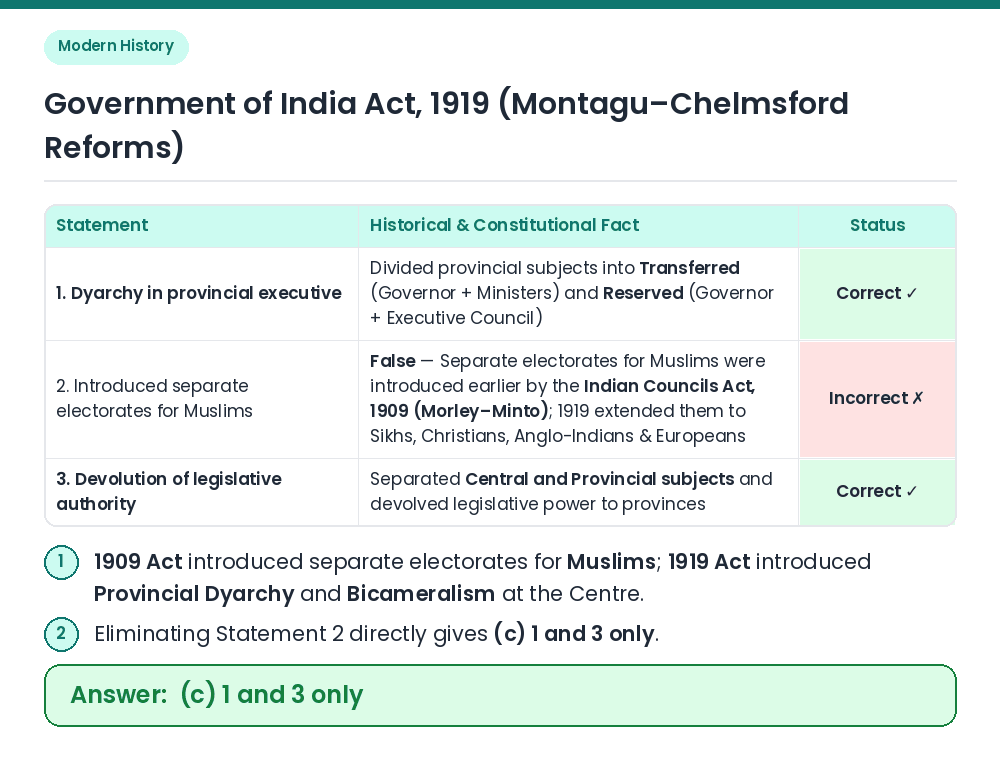
Which of the following is/are the principal feature(s) of the Government of India Act, 1919? 1. Introduction of dyarchy in the executive government of the provinces 2. Introduction of separate communal electorates for Muslims 3. Devolution of legislative authority by the centre to the provinces Select the correct answer using the codes given below :
Show answer & explanationShow explanation
Answer: (C) 1 and 3 only
Given / Concept: The Government of India Act, 1919 (Montagu–Chelmsford Reforms) introduced gradual responsible government in British India. Statement 1 & 3 Analysis: The Act demarcated and separated Central and Provincial subjects, devolving legislative authority to the provinces (3), and further divided provincial subjects into 'Transferred' and 'Reserved' categories—introducing Dyarchy in the provinces (1) ⇒ Statements 1 and 3 are correct. Statement 2 Analysis: Separate communal electorates for Muslims were introduced by the Indian Councils Act, 1909 (Morley–Minto Reforms), not the 1919 Act (which extended communal representation to Sikhs, Indian Christians, Anglo-Indians, and Europeans) ⇒ Statement 2 is incorrect. Result: Statements 1 and 3 only are correct. Related Facts: Other key provisions of the Government of India Act, 1919: • Bicameralism & Direct Elections: Introduced a bicameral legislature at the Centre (Council of State and Legislative Assembly) and direct elections for the first time. • Public Service Commission: Provided for the establishment of a Central Public Service Commission (set up in 1926 based on Lee Commission). • Statutory Commission: Provided for a review commission after 10 years (which led to the appointment of the Simon Commission in 1927). Correct Answer: (c) 1 and 3 only