Civil Services Examination · Question 48
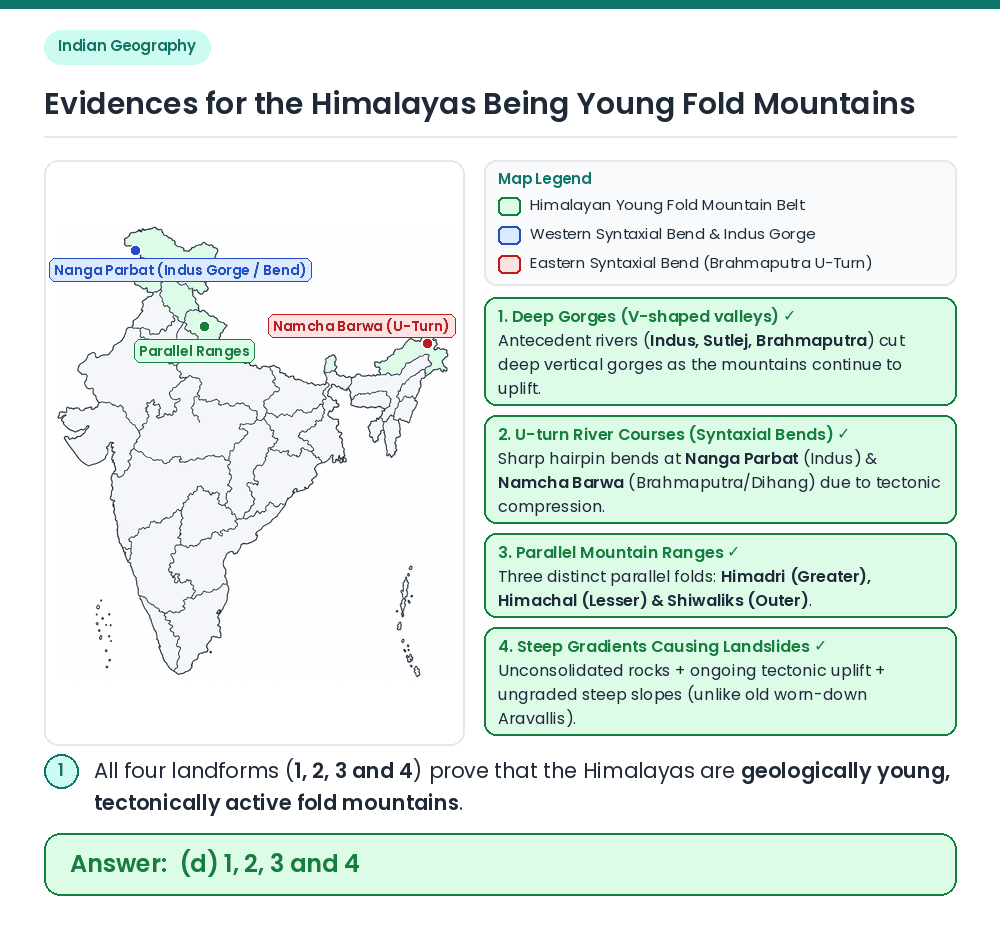
When you travel in Himalayas, you will see the following : 1. Deep gorges 2. U-turn river courses 3. Parallel mountain ranges 4. Steep gradients causing land-sliding Which of the above can be said to be the evidences for Himalayas being young fold mountains?
Show answer & explanationShow explanation
Answer: (D) 1, 2, 3 and 4
Given / Concept: The Himalayas were formed during the Tertiary/Alpine orogeny by the collision of the Indian and Eurasian tectonic plates and are still uplifting today. Analysis of 1 & 2: Deep V-shaped gorges (1) carved by antecedent rivers keeping pace with tectonic uplift, and sharp U-turn river courses (2) around the western and eastern syntaxial bends (Nanga Parbat and Namcha Barwa) are classic structural signatures of young fold mountains ⇒ 1 and 2 are correct. Analysis of 3 & 4: Parallel mountain ranges—Greater Himalayas, Lesser Himalayas, and Shiwaliks—formed by successive compressional folding phases (3), along with ungraded steep gradients prone to frequent landslides (4, unlike eroded old fold mountains like the Aravallis) prove their youthfulness ⇒ 3 and 4 are correct. Result: All four features (1, 2, 3 and 4) are evidences for the Himalayas being young fold mountains. Related Facts: Key geological features of the Himalayas: • Three Parallel Ranges: Himadri (Greater Himalayas, avg. height 6,000 m), Himachal (Lesser Himalayas, 3,700–4,500 m), and Shiwaliks (Outer Himalayas, 900–1,100 m). • Syntaxial Bends: Hairpin knee-bends at Nanga Parbat in the northwest (Indus gorge) and Namcha Barwa in the northeast (Dihang/Brahmaputra gorge). • Contrast with Old Fold Mountains: The Aravallis (India), Urals (Russia), and Appalachians (USA) are ancient fold mountains worn down into low, rounded residual hills. Correct Answer: (d) 1, 2, 3 and 4