Civil Services Examination · Question 1
Directions: Read the following passage and answer the item that follows. Your answer to this item should be based on the passage only. Passage – 1 The subject of democracy has become severely muddled because of the way the rhetoric surrounding it has been used in recent years. There is, increasingly, an oddly confused dichotomy between those who want to 'impose' democracy on countries in the non-Western world (in these countries' 'own interest', of course) and those who are opposed to such 'imposition' (because of the respect for the countries' 'own ways'). But the entire language of 'imposition', used by both sides, is extraordinarily inappropriate since it makes the implicit assumption that democracy belongs exclusively to the West, taking it to be a quintessentially 'Western' idea which has originated and flourished only in the West. But the thesis and the pessimism it generates about the possibility of democratic practice in the world would be extremely hard to justify. There were several experiments in local democracy in ancient India. Indeed, in understanding the roots of democracy in the world, we have to take an interest in the history of people participation and public reasoning in different parts of the world. We have to look beyond thinking of democracy only in terms of European and American evolution. We would fail to understand the pervasive demands for participatory living, on which Aristotle spoke with far-reaching insight, if we take democracy to be a kind of a specialized cultural product of the West. It cannot, of course, be doubted that the institutional structure of the contemporary practice of democracy is largely the product of European and American experience over the last few centuries. This is extremely important to recognize since these developments in institutional formats were immensely innovative and ultimately effective. There can be little doubt that there is a major 'Western' achievement here. Which of the following is closest to the view of democracy as mentioned in the above passage?
Show answer & explanationShow explanation
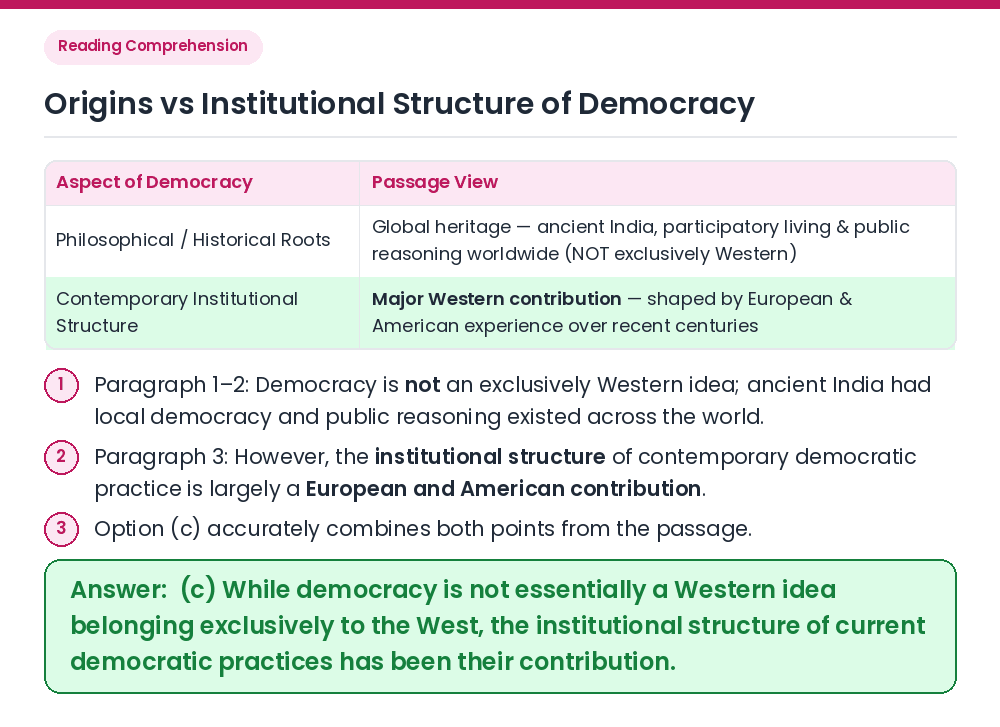
Answer: (C) While democracy is not essentially a Western idea belonging exclusively to the West, the institutional structure of current democratic practices has been their contribution.
Concept: Identify the author's balanced thesis on the historical roots and modern institutions of democracy. Non-exclusive roots: Paragraphs 1 and 2 reject the assumption that democracy belongs exclusively to the West ⇒ ancient India had local democracy and public reasoning existed globally. Western institutional contribution: Paragraph 3 states that the institutional structure of contemporary democracy is largely the product of European and American experience. Option check: Option (a) attributes the muddle to a deliberate desire rather than rhetoric; Option (b) endorses the 'own ways' dichotomy criticized in Paragraph 1. Result: Option (c) captures both the global roots and the Western institutional contribution. Correct Answer: (c) While democracy is not essentially a Western idea belonging exclusively to the West, the institutional structure of current democratic practices has been their contribution.