Civil Services Examination · Question 43
An increase in the Bank Rate generally indicates that the
Show answer & explanationShow explanation
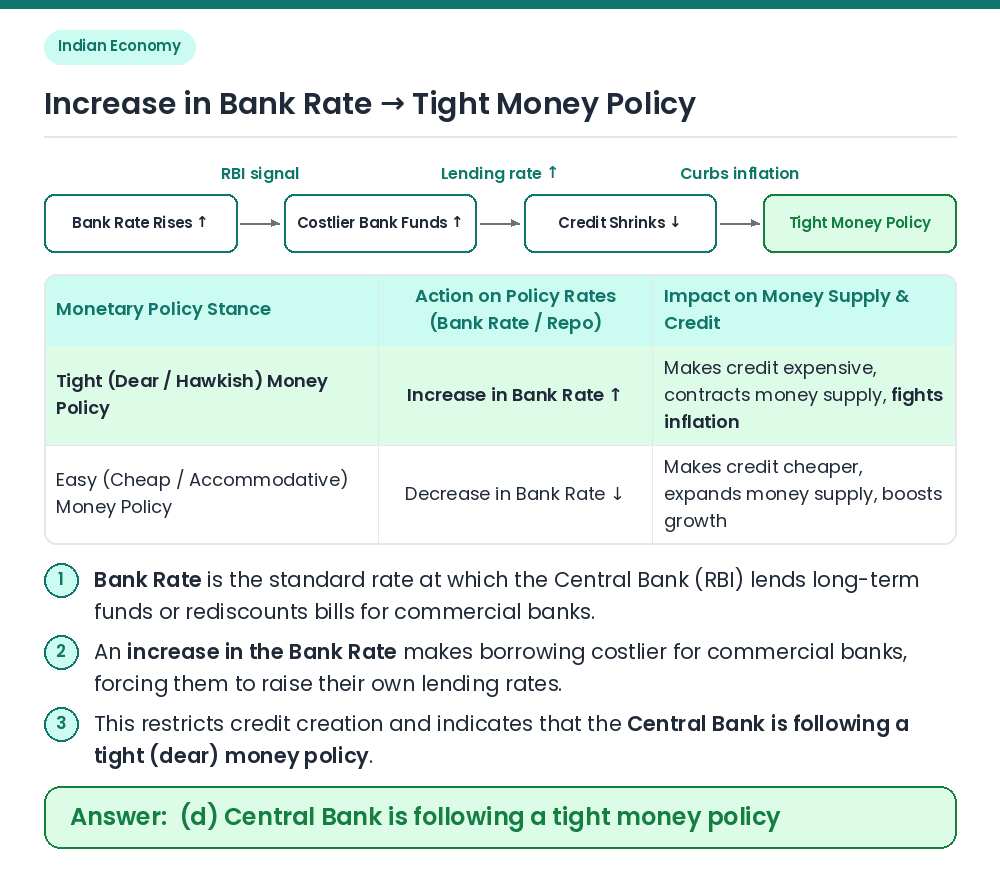
Answer: (D) Central Bank is following a tight money policy
Concept: Bank Rate (defined under Section 49 of the RBI Act, 1934) is the rate at which the Central Bank is ready to buy or rediscount bills of exchange or other commercial papers, serving as a benchmark for long-term lending. Transmission Mechanism: When the Central Bank increases the Bank Rate, the cost of funds for commercial banks rises. Commercial banks pass this on by raising their market lending rates (so option a is false), which reduces credit demand and contracts money supply. Policy Stance: Raising policy interest rates to make credit dearer and curb inflation is called a 'tight money policy' (or 'dear money policy'), whereas lowering rates is an 'easy money policy'. Result: An increase in the Bank Rate indicates that the Central Bank is following a tight money policy. Related Facts: • Alignment with MSF Rate: In India, the Bank Rate is aligned with the Marginal Standing Facility (MSF) rate and also acts as the penal rate for shortfalls in CRR/SLR. • Repo Rate vs Bank Rate: Repo rate governs short-term liquidity against government securities with a repurchase agreement, whereas Bank Rate applies without repurchase collateral. Correct Answer: (d) Central Bank is following a tight money policy