Civil Services Examination · Question 7
A group of 630 children is seated in rows for a group photo session. Each row contains three less children than the row in front of it. Which one of the following number of rows is not possible?
Show answer & explanationShow explanation
Answer: (D) 6
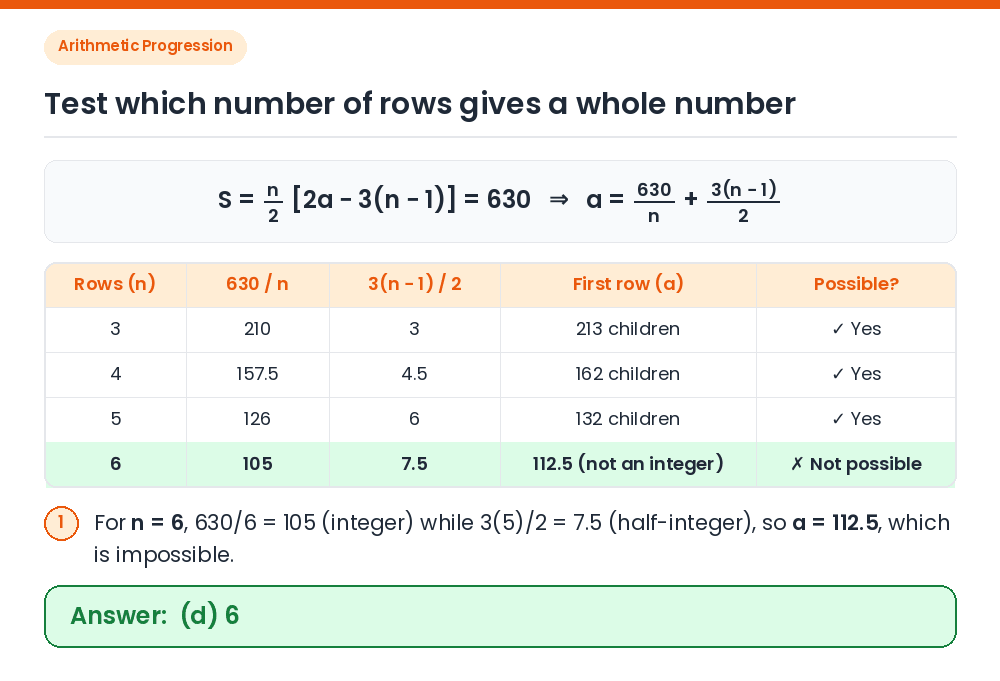
Given / Concept: Let n be the number of rows and a be the number of children in the first row. The rows form an AP with common difference d = −3 and sum S = 630. Formula: S = (n/2)[2a − 3(n − 1)] = 630 ⇒ a = (630/n) + 3(n − 1)/2, which must be a positive integer. Test options: ⇒ For n = 3: a = 210 + 3 = 213 (integer). ⇒ For n = 4: a = 157.5 + 4.5 = 162 (integer). ⇒ For n = 5: a = 126 + 6 = 132 (integer). ⇒ For n = 6: a = 105 + 7.5 = 112.5 (not an integer). Result: Since the number of children in the first row cannot be 112.5, 6 rows is not possible. Shortcut: For even n, 630/n must end in .5 so that adding 3(n−1)/2 (which also ends in .5) gives an integer; 630/6 = 105 (whole), so 105 + 7.5 = 112.5 fails. Correct Answer: (d) 6