Civil Services Examination · Question 33
In the context of Indian economy, which of the following is/are the purpose/purposes of 'Statutory Reserve Requirements'? 1. To enable the Central Bank to control the amount of advances the banks can create 2. To make the people's deposits with banks safe and liquid 3. To prevent the commercial banks from making excessive profits 4. To force the banks to have sufficient vault cash to meet their day-to-day requirements Select the correct answer using the code given below.
Show answer & explanationShow explanation
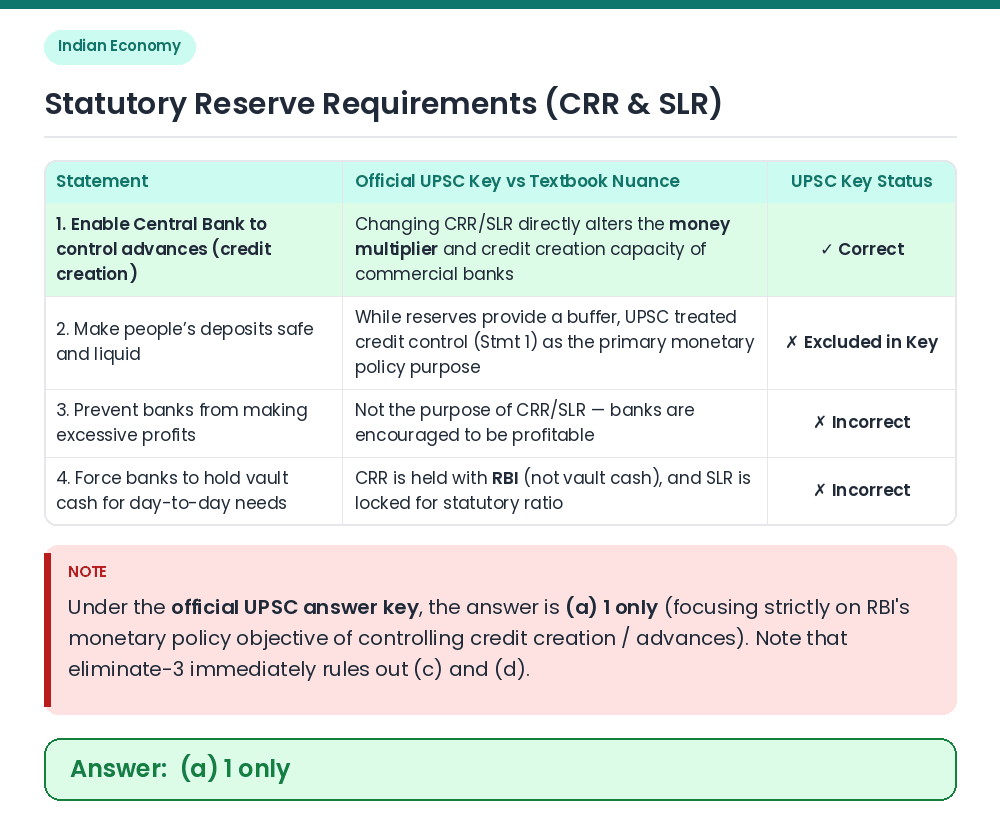
Answer: (A) 1 only
Concept: Statutory Reserve Requirements in India comprise the Cash Reserve Ratio (CRR, under Section 42 of the RBI Act, 1934) and the Statutory Liquidity Ratio (SLR, under Section 24 of the Banking Regulation Act, 1949). Statement 1: By varying CRR and SLR, the RBI directly controls the lendable resources and money multiplier of commercial banks, thereby controlling the volume of credit/advances they can create. ⇒ Statement 1 is definitely correct. Statements 3 & 4: Reserve requirements are not meant to cap bank profits (3 is false), nor is CRR kept as vault cash for daily operations (CRR is parked with RBI; 4 is false). Statement 2 & Official Key Note: Although textbooks often mention solvency/liquidity of deposits as a secondary rationale for SLR, the official UPSC answer key selected (a) '1 only', treating monetary control over credit creation as the primary purpose. Related Facts: • CRR must be maintained in cash with the RBI (earns no interest); SLR can be maintained in cash, gold, or unencumbered approved government securities. Correct Answer: (a) 1 only