Civil Services Examination · Question 56
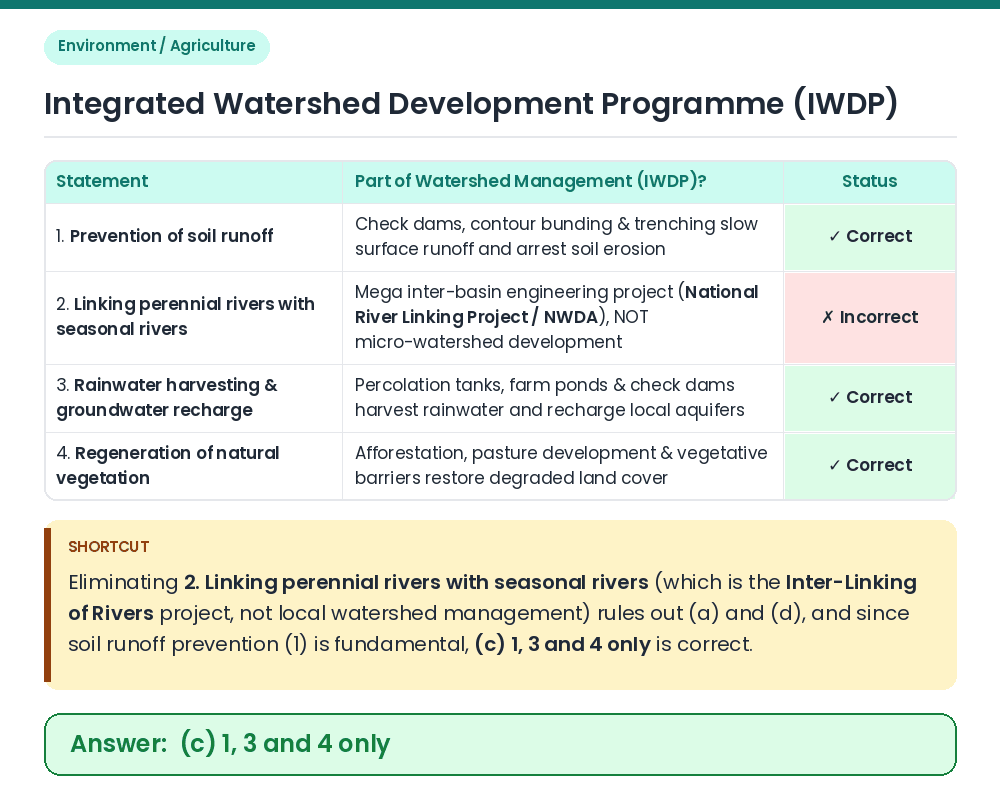
What are the benefits of implementing the 'Integrated Watershed Development Programme'? 1. Prevention of soil runoff 2. Linking the country's perennial rivers with seasonal rivers 3. Rainwater harvesting and recharge of groundwater table 4. Regeneration of natural vegetation Select the correct answer using the code given below.
Show answer & explanationShow explanation
Answer: (C) 1, 3 and 4 only
Concept: Watershed management involves conserving soil, water, and biomass within a local hydrological drainage unit (micro-watershed) through check dams, contour bunds, farm ponds, and afforestation. Benefits — 1, 3 & 4: Implementing IWDP prevents topsoil runoff (1), harvests rainwater to recharge the groundwater table (3), and promotes the regeneration of natural vegetation and pastures (4). ⇒ 1, 3 and 4 are correct. Eliminate 2: Linking the country's perennial (Himalayan) rivers with seasonal (Peninsular) rivers falls under the National Perspective Plan / Inter-Linking of Rivers (NWDA), not local watershed development. ⇒ 2 is incorrect. Result: Only 1, 3 and 4 are benefits of the Integrated Watershed Development Programme. Related Facts: • IWDP, DPAP, and DDP were consolidated into the Integrated Watershed Management Programme (IWMP) under the Department of Land Resources. Correct Answer: (c) 1, 3 and 4 only