Civil Services Examination · Question 94
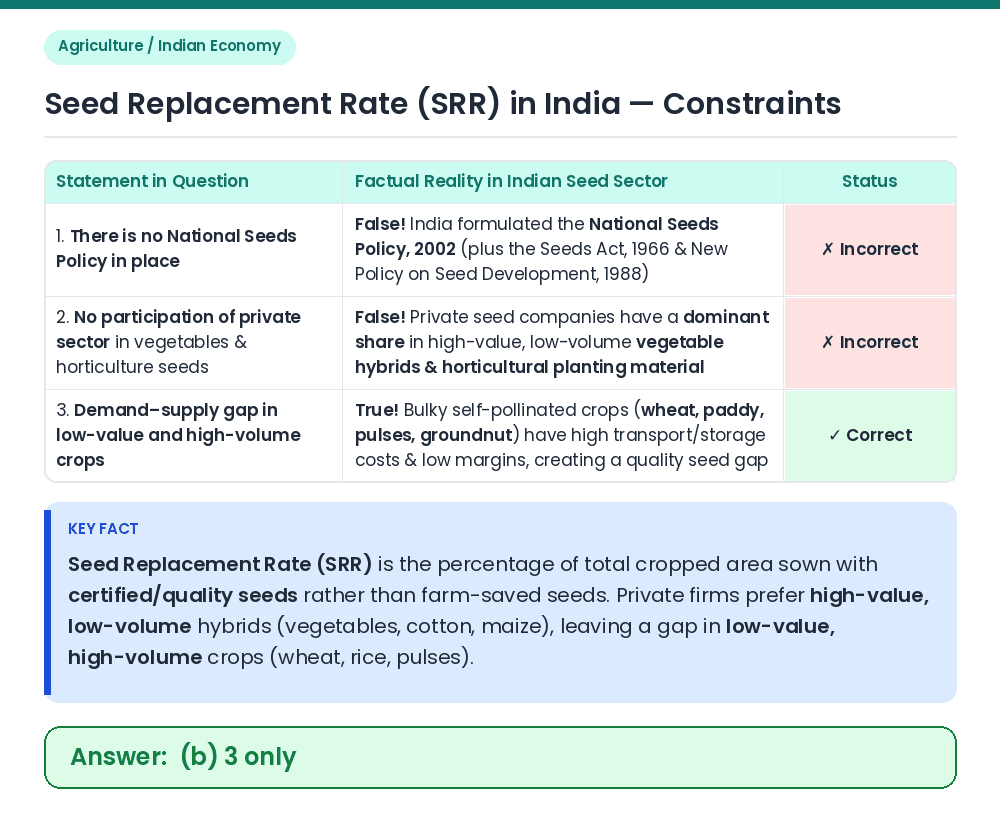
In the context of food and nutritional security of India, enhancing the 'Seed Replacement Rates' of various crops helps in achieving the food production targets of the future. But what is/are the constraint/constraints in its wider/greater implementation? 1. There is no National Seeds Policy in place. 2. There is no participation of private sector seed companies in the supply of quality seeds of vegetables and planting materials of horticultural crops. 3. There is a demand-supply gap regarding quality seeds in case of low value and high volume crops. Select the correct answer using the code given below.
Show answer & explanationShow explanation
Answer: (B) 3 only
Statement 1: India has had the National Seeds Policy, 2002 (along with the Seeds Act, 1966 and National Seed Plan) in place for decades. ⇒ Statement 1 is false. Statement 2: Private sector seed companies actively participate — and in fact hold a major market share — in supplying high-value, low-volume hybrid vegetable seeds and horticultural planting materials. ⇒ Statement 2 is false. Statement 3: In the case of low-value and high-volume self-pollinated crops (such as wheat, paddy, pulses, and groundnut), high seed bulk, high transportation/storage costs, and low profit margins deter private players, leading to a persistent demand-supply gap in certified quality seeds. ⇒ Statement 3 is correct. Result: Only statement 3 is a genuine constraint. Related Facts: • Desired SRR benchmarks: ~25–33% for self-pollinated crops (wheat, paddy), ~50% for cross-pollinated crops, and 100% for hybrids. Correct Answer: (b) 3 only