Civil Services Examination · Question 4
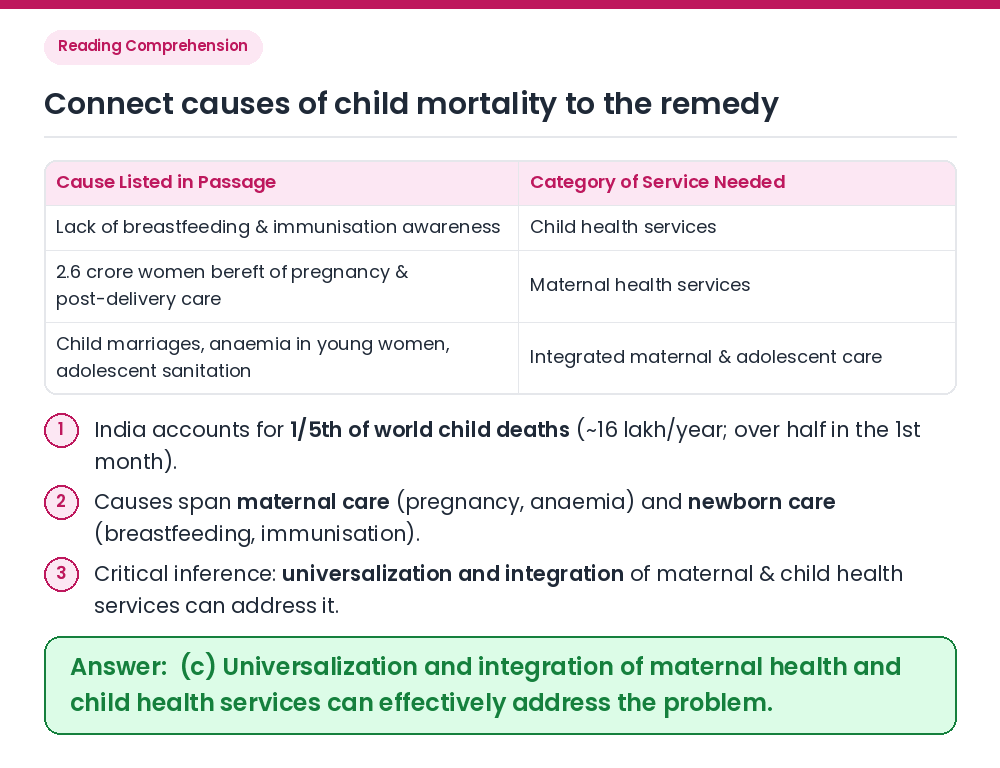
Passage – 4: India accounts for nearly a fifth of the world's child deaths. In terms of numbers, it is the highest in the world — nearly 16 lakhs every year. Of these, more than half die in the first month of life. Officials believe that the reason for this is the absence of steps to propagate basic health practices relating to breast feeding and immunisation. Also the large reproductive population of 2.6 crore remains bereft of care during the critical phases of pregnancy and post-delivery. Added to this is the prevalence of child marriages, anaemia among young women and lack of focus on adolescent sanitation, all of which impact child death rates. Which is the critical inference that can be made from the above passage?
Show answer & explanationShow explanation
Answer: (C) Universalization and integration of maternal health and child health services can effectively address the problem.
Given / Concept: High infant mortality in India is driven by gaps in both newborn practices (breastfeeding, immunisation) and maternal health (pregnancy/post-delivery care, anaemia, sanitation). Evaluate options: (a) illiteracy and (b) government inability are not stated; (d) directly contradicts the mention of anaemia among young women. Deduce inference: Since maternal and child health factors are intertwined and 2.6 crore women lack care, universalizing and integrating both services will effectively address the problem. Result: Option (c) is the critical inference. Correct Answer: (c) Universalization and integration of maternal health and child health services can effectively address the problem.