Civil Services Examination · Question 37
When a bill is referred to a joint sitting of both the Houses of the Parliament, it has to be passed by
Show answer & explanationShow explanation
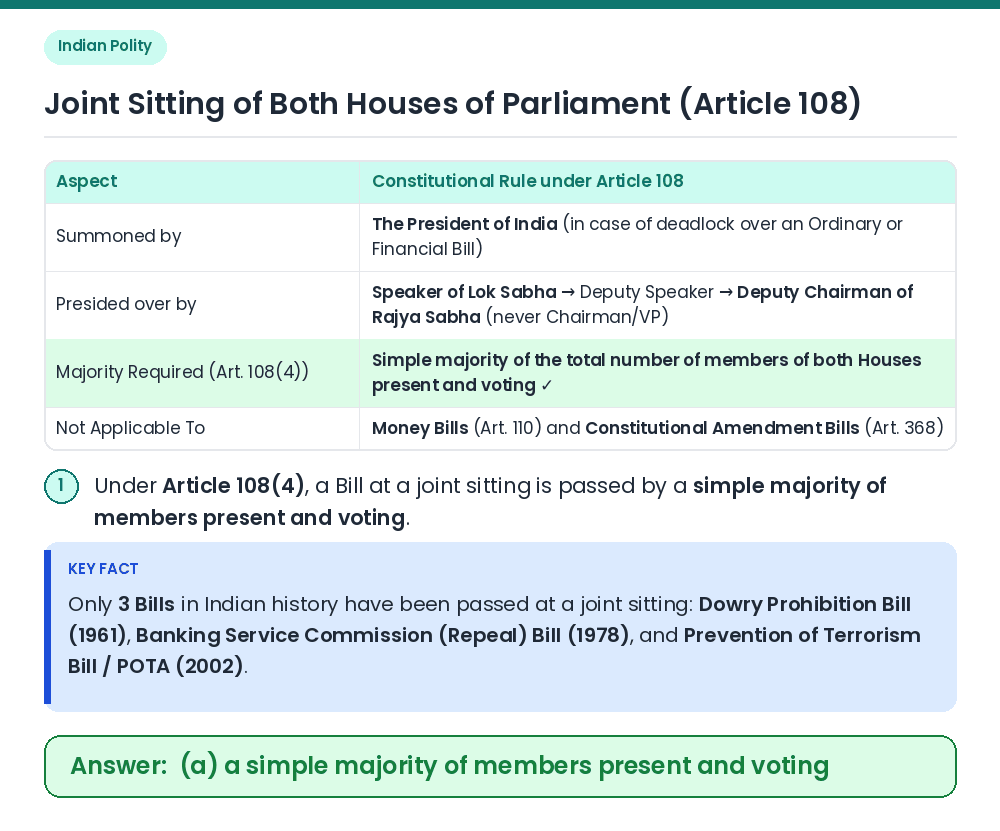
Answer: (A) a simple majority of members present and voting
Concept: Article 108 of the Constitution provides for a joint sitting of both Houses of Parliament to resolve a deadlock over an Ordinary Bill or a Financial Bill. Majority Requirement under Art. 1084: ⇒ If at the joint sitting the Bill is passed by a majority of the total number of members of both Houses present and voting (i.e. a simple majority), it is deemed to have been passed by both Houses. Conclusion: A bill at a joint sitting has to be passed by a simple majority of members present and voting. • Related Facts: Since the Lok Sabha has more than twice the numerical strength of the Rajya Sabha (543 vs 245), the Lok Sabha generally prevails in a joint sitting. • Exceptions: A joint sitting cannot be summoned for a Money Bill or a Constitutional Amendment Bill (Article 368). Correct Answer: (a) a simple majority of members present and voting