Civil Services Examination · Question 5
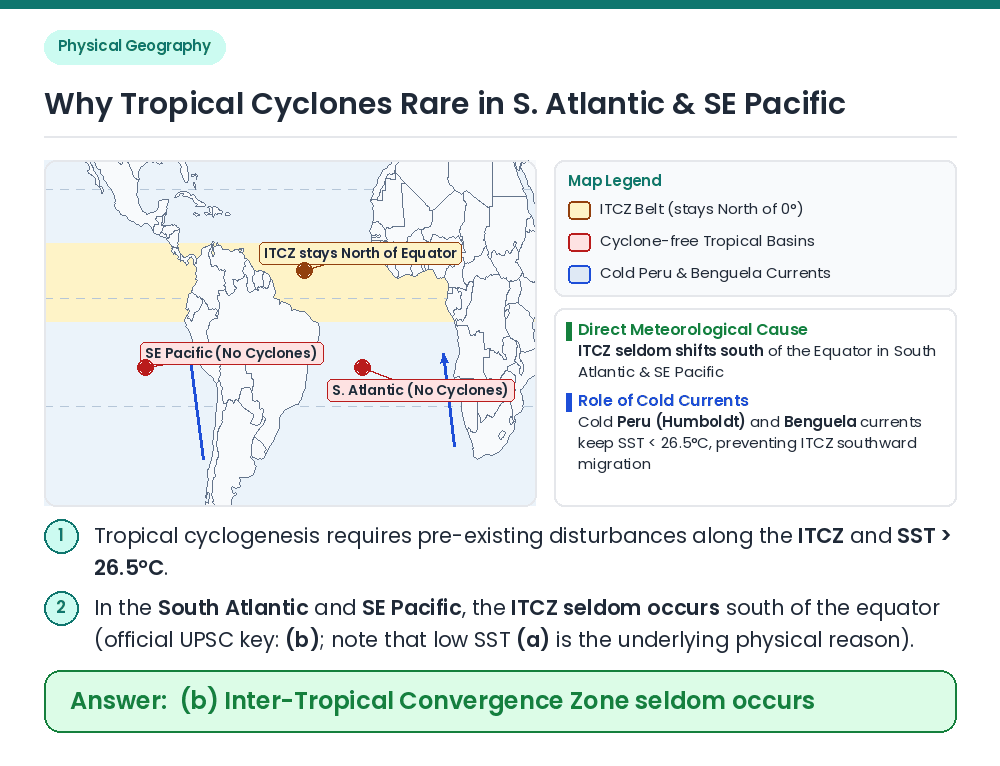
In the South Atlantic and South-Eastern Pacific regions in tropical latitudes, cyclone does not originate. What is the reason?
Show answer & explanationShow explanation
Answer: (B) Inter-Tropical Convergence Zone seldom occurs
Concept: Tropical cyclones require warm ocean waters (>26.5°C), sufficient Coriolis force (beyond 5° latitude), low vertical wind shear, and low-level convergence along the Inter-Tropical Convergence Zone (ITCZ). Mechanism in S. Atlantic & SE Pacific: ⇒ In the South Atlantic and South-Eastern Pacific, the ITCZ stays near or north of the equator throughout the year and seldom shifts into southern tropical latitudes to provide the needed cyclonic vorticity. Note on Option a vs Option b: ⇒ Cold ocean currents (Benguela Current in the South Atlantic and Peru/Humboldt Current in the SE Pacific) keep sea surface temperatures low, which is the root cause preventing the ITCZ from shifting south; however, UPSC's official key selected (b) 'Inter-Tropical Convergence Zone seldom occurs' as the direct synoptic reason. Conclusion: Option (b) is the official correct answer. • Related Facts: Coriolis force is zero only at the Equator (0°–5°), not across the entire tropical belt (5°–23.5°S). • Rare Exception: Hurricane Catarina (March 2004) was a rare extratropical-to-tropical transition cyclone in the South Atlantic. Correct Answer: (b) Inter-Tropical Convergence Zone seldom occurs