Civil Services Examination · Question 65
'Basel III Accord' or simply 'Basel III', often seen in the news, seeks to
Show answer & explanationShow explanation
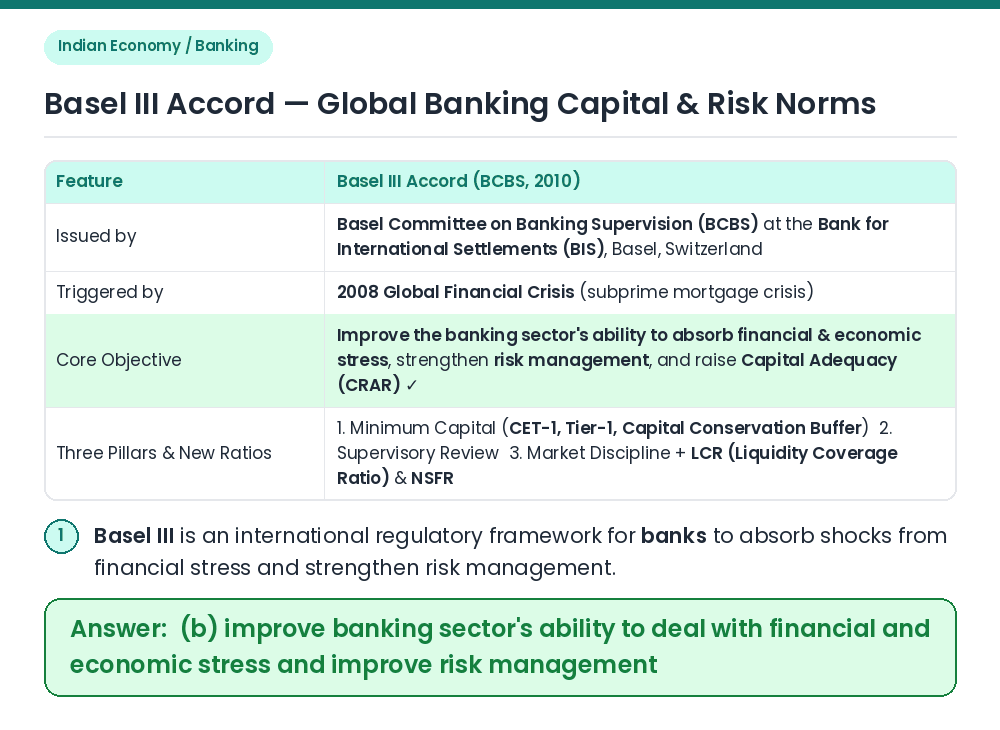
Answer: (B) improve banking sector's ability to deal with financial and economic stress and improve risk management
Concept: The Basel III Accord is a comprehensive set of international banking reform measures developed by the Basel Committee on Banking Supervision (BCBS) in 2010 in response to the 2008 Global Financial Crisis. Identify Core Objective: ⇒ It seeks to improve the banking sector's ability to absorb shocks arising from financial and economic stress, improve risk management and governance, and strengthen banks' transparency and disclosures. Eliminate Other Options: ⇒ Option (a) relates to the CBD, option (c) relates to the Kyoto Protocol, and option (d) relates to the Montreal Protocol. Conclusion: Basel III seeks to improve the banking sector's ability to deal with financial and economic stress and improve risk management. • Related Facts: Under RBI's Basel III norms, Indian Scheduled Commercial Banks must maintain a minimum Capital to Risk-weighted Assets Ratio (CRAR) of 9% (plus a 2.5% Capital Conservation Buffer = 11.5%). • Liquidity Norms: Basel III introduced two new liquidity standards — Liquidity Coverage Ratio (LCR) and Net Stable Funding Ratio (NSFR). Correct Answer: (b) improve banking sector's ability to deal with financial and economic stress and improve risk management