Civil Services Examination · Question 94
The problem of international liquidity is related to the non-availability of
Show answer & explanationShow explanation
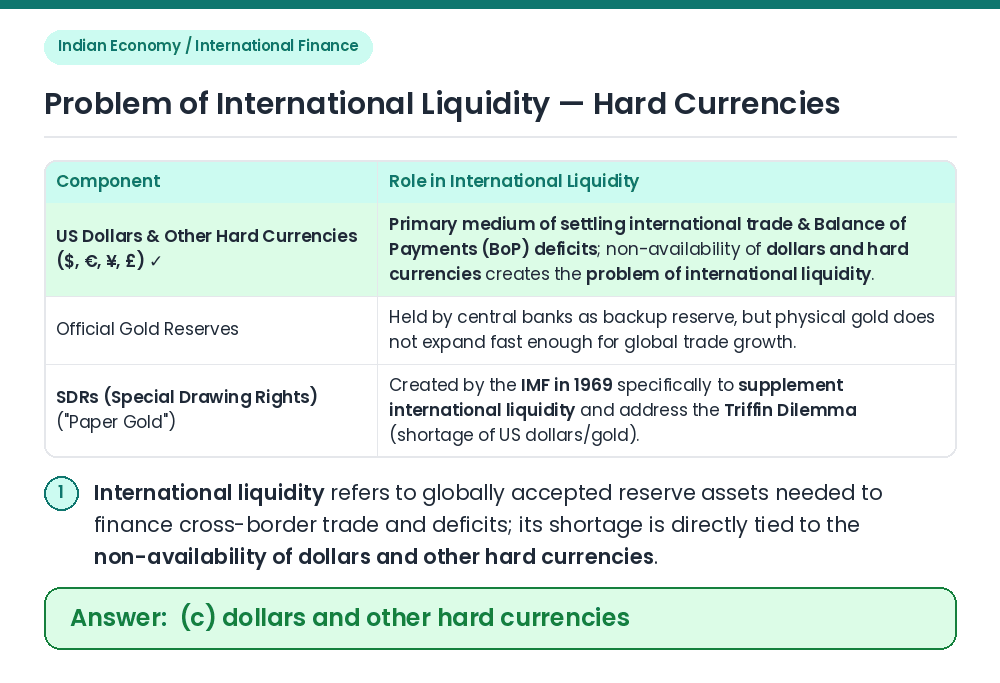
Answer: (C) dollars and other hard currencies
Concept: In international economics, 'international liquidity' refers to the stock of internationally acceptable reserve assets held by central banks to settle Balance of Payments (BoP) deficits and finance global trade. Identify Core Bottleneck: ⇒ Because cross-border trade and debt settlements are overwhelmingly invoiced in universally accepted convertible ('hard') currencies — primarily the US Dollar ($), Euro (€), Japanese Yen (¥), British Pound (£) — the problem of international liquidity arises from the shortage or non-availability of dollars and other hard currencies. Conclusion: The problem of international liquidity is related to the non-availability of dollars and other hard currencies. • Related Facts: To alleviate the shortage of international liquidity (highlighted by Economist Robert Triffin's 'Triffin Dilemma'), the IMF created Special Drawing Rights (SDRs, also called 'Paper Gold') in 1969. • SDR Basket: The value of the IMF's SDR is based on a basket of five hard currencies — US Dollar, Euro, Chinese Renminbi, Japanese Yen and British Pound Sterling. Correct Answer: (c) dollars and other hard currencies