Civil Services Examination · Question 24
Read the following passage and answer the item that follows. Your answer to this item should be based on the passage only. Passage: Biomass as fuel for power, heat, and transport has the highest mitigation potential of all renewable sources. It comes from agriculture and forest residues as well as from energy crops. The biggest challenge in using biomass residues is a long-term reliable supply delivered to the power plant at reasonable costs; the key problems are logistical constraints and the costs of fuel collection. Energy crops, if not managed properly, compete with food production and may have undesirable impacts on food prices. Biomass production is also sensitive to the physical impacts of a changing climate. Projections of the future role of biomass are probably overestimated, given the limits to the sustainable biomass supply, unless breakthrough technologies substantially increase productivity. Climate-energy models project that biomass use could increase nearly four-fold to around 150 – 200 exajoules, almost a quarter of world primary energy in 2050. However the maximum sustainable technical potential of biomass resources (both residues and energy crops) without disruption of food and forest resources ranges from 80 – 170 exajoules a year by 2050, and only part of this is realistically and economically feasible. In addition, some climate models rely on biomass-based carbon capture and storage, an unproven technology, to achieve negative emissions and to buy some time during the first half of the century. Some liquid biofuels such as corn-based ethanol, mainly for transport, may aggravate rather than ameliorate carbon emissions on a life-cycle basis. Second generation biofuels, based on ligno-cellulosic feedstocks – such as straw, bagasse, grass and wood – hold the promise of sustainable production that is high-yielding and emit low levels of greenhouse gases, but these are still in the R & D stage. With reference to the passage, following assumptions have been made: 1. Some climate-energy models suggest that the use of biomass as a fuel for power generation helps in mitigating greenhouse gas emissions 2. It is not possible to use biomass as a fuel for power generation without disrupting food and forest resources Which of these assumptions is/are valid?
Show answer & explanationShow explanation
Answer: (A) 1 only
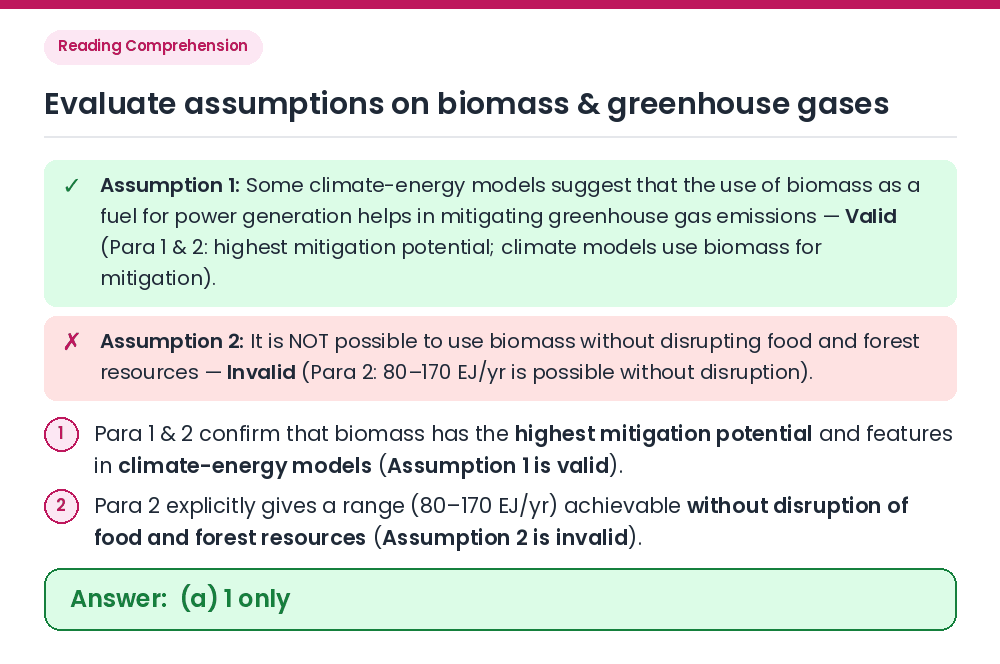
Concept: Check each assumption against the text on climate-energy models and sustainable technical potential. Check Assumption 1: Paragraph 1 states biomass has the highest mitigation potential and Paragraph 2 discusses climate-energy models projecting biomass expansion to curb emissions ⇒ Assumption 1 is valid. Check Assumption 2: Paragraph 2 explicitly states that 80–170 exajoules per year can be achieved 'without disruption of food and forest resources' ⇒ Assumption 2 is invalid. Result: Only assumption 1 is valid. Correct Answer: (a) 1 only