Civil Services Examination · Question 43
Read the following passage and answer the item that follows. Your answer to this item should be based on the passage only. Passage: Understanding of the role of biodiversity in the hydrological cycle enables better policy-making. The term biodiversity refers to the variety of plants, animals, microorganisms, and the ecosystems in which they occur. Water and biodiversity are interdependent. In reality, the hydrological cycle decides how biodiversity functions. In turn, vegetation and soil drive the movement of water. Every glass of water we drink has, at least in part, passed through fish, trees, bacteria, soil and other organisms. Passing through these ecosystems, it is cleansed and made fit for consumption. The supply of water is a critical service that the environment provides. Which among the following is the most critical inference that can be made from the above passage?
Show answer & explanationShow explanation
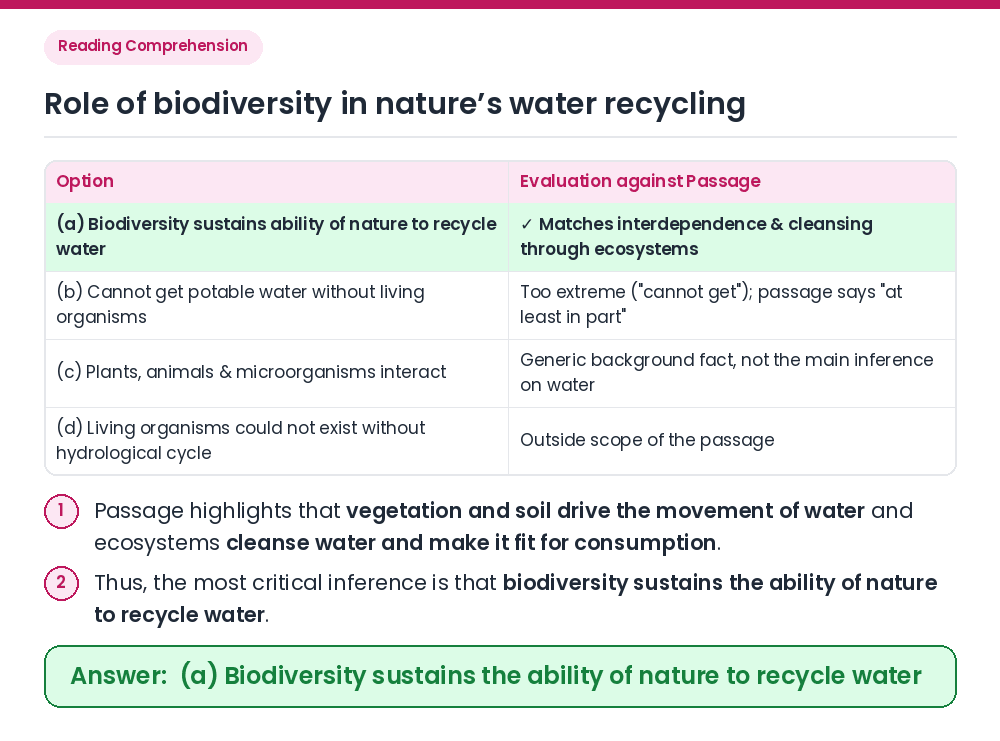
Answer: (A) Biodiversity sustains the ability of nature to recycle water
Concept: Identify the central takeaway linking biodiversity and the hydrological cycle. Analyze passage: Vegetation and soil drive the movement of water, and as water passes through fish, trees, bacteria, and soil ecosystems, it is cleansed and recycled for consumption. Eliminate b, c, d: Option (b) is overly absolute ('cannot get', whereas passage says 'at least in part'); (c) omits the water cycle; (d) is speculative about evolutionary origins. Result: Biodiversity sustains the ability of nature to recycle water. Correct Answer: (a) Biodiversity sustains the ability of nature to recycle water