Civil Services Examination · Question 48
Read the following passage and answer the item that follows. Your answer to this item should be based on the passage only. Passage: About 15 per cent of global greenhouse gas emissions come from agricultural practices. This includes nitrous oxide from fertilizers; methane from livestock, rice production, and manure storage; and carbon dioxide (CO2) from burning biomass, but this excludes CO2 emissions from soil management practices, savannah burning and deforestation. Forestry, land use, and land-use change account for another 17 per cent of greenhouse gas emissions each year, three quarters of which come from tropical deforestation. The remainder is largely from draining and burning tropical peatland. About the same amount of carbon is stored in the world's peatlands as is stored in the Amazon rainforest. Which among the following is the most logical and rational inference that can be made from the above passage?
Show answer & explanationShow explanation
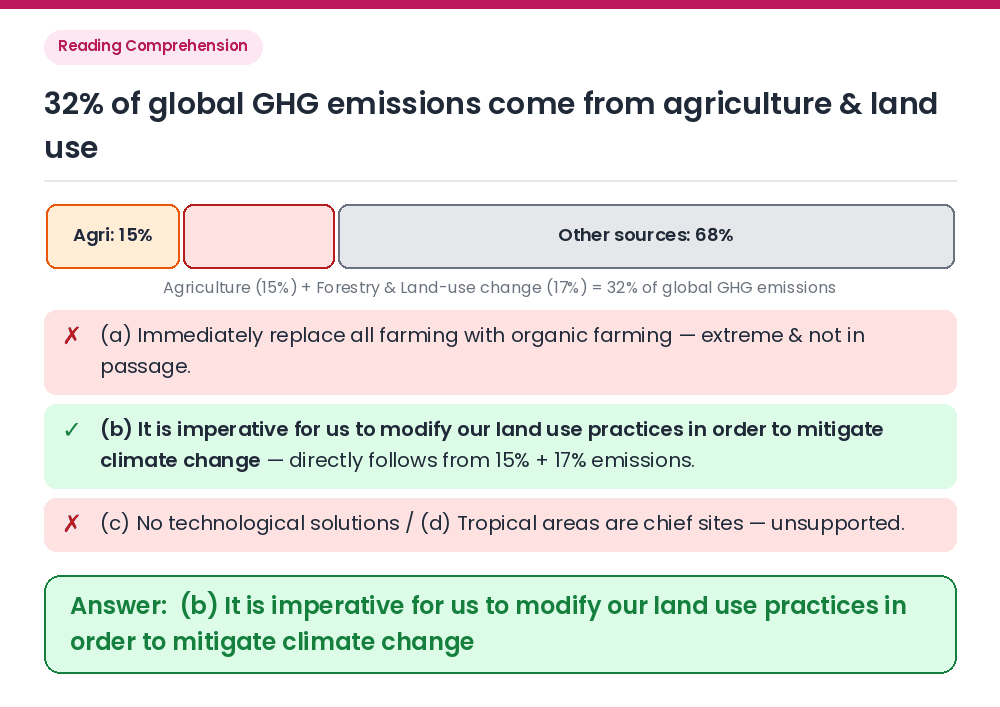
Answer: (B) It is imperative for us to modify our land use practices in order to mitigate climate change
Concept: Identify the logical conclusion from the data on agricultural, forestry, and land-use greenhouse gas emissions. Analyze passage data: Agricultural practices (15%) plus forestry, land use, and land-use change such as deforestation and draining/burning peatlands (17%) account for ~32% of global greenhouse gas emissions. Eliminate a, c, d: Option (a) is extreme ('immediately replace... all over the world'); (c) is unmentioned; (d) overgeneralizes the comparison between peatlands and the Amazon. Result: Modifying our land-use practices is imperative to mitigate climate change. Correct Answer: (b) It is imperative for us to modify our land use practices in order to mitigate climate change