Civil Services Examination · Question 50
With reference to the religious history of India, consider the following statements : 1. The concept of Bodhisattva is central to Hinayana sect of Buddhism. 2. Bodhisattva is a compassionate one on his way to enlightenment. 3. Bodhisattva delays achieving his own salvation to help all sentient beings on their path to it. Which of the statements given above is/are correct?
Show answer & explanationShow explanation
Answer: (B) 2 and 3 only
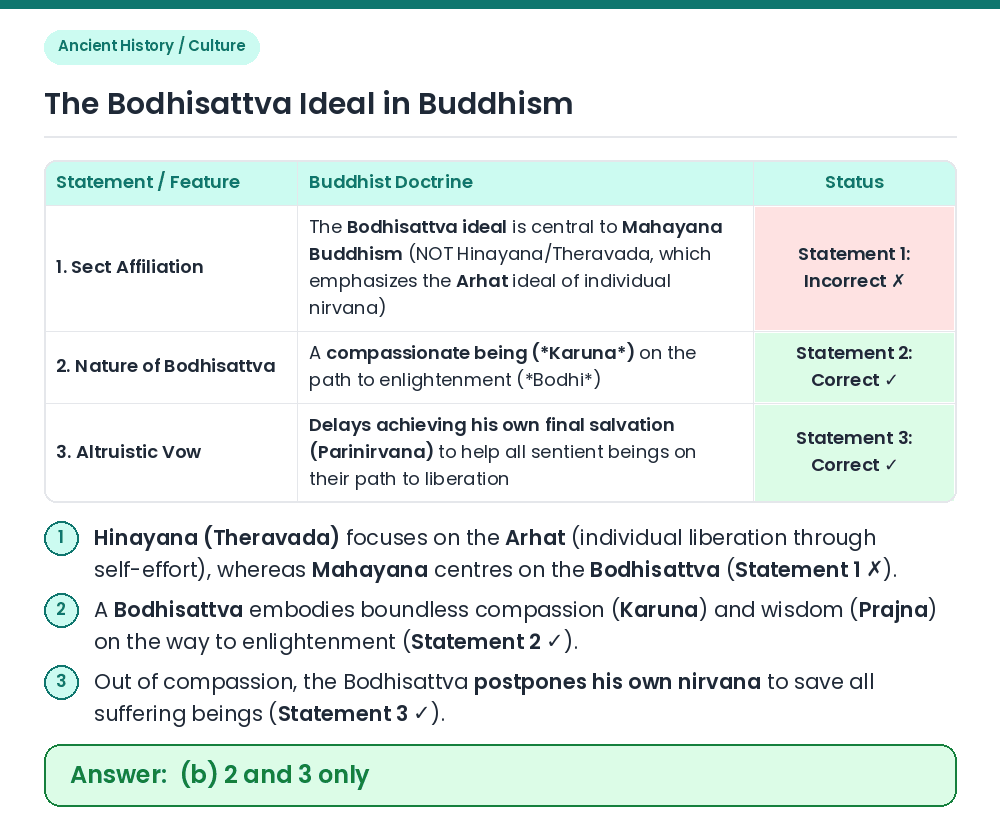
Concept: A Bodhisattva ('one whose essence is enlightenment') is a central spiritual ideal in Buddhist philosophy. Statement 1: The concept of the Bodhisattva as a universal saviour is central to the Mahayana ('Great Vehicle') sect of Buddhism, whereas the Hinayana/Theravada sect emphasizes the ideal of the 'Arhat' (who attains individual nirvana) ⇒ Statement 1 is incorrect. Statements 2 & 3: In Mahayana Buddhism, a Bodhisattva is a compassionate being on his way to enlightenment (2 is correct) who delays his own final nirvana/salvation out of compassion (Karuna) in order to help all sentient beings achieve liberation (3 is prominent Mahayana doctrine — correct). Result: Statements 2 and 3 only are correct. Related Facts: • Prominent Bodhisattvas: Avalokiteshvara / Padmapani (Compassion), Manjushri (Wisdom), Vajrapani (Power), Maitreya (Future Buddha), and Kshitigarbha. • Six Paramitas (Perfections): A Bodhisattva practices Dana (generosity), Sila (morality), Kshanti (patience), Virya (energy), Dhyana (meditation), and Prajna (wisdom). • Fourth Buddhist Council: Held in Kashmir (Kundalavana) under Kanishka (~1st century CE), where the division between Mahayana and Hinayana crystallized. Correct Answer: (b) 2 and 3 only