Civil Services Examination · Question 59
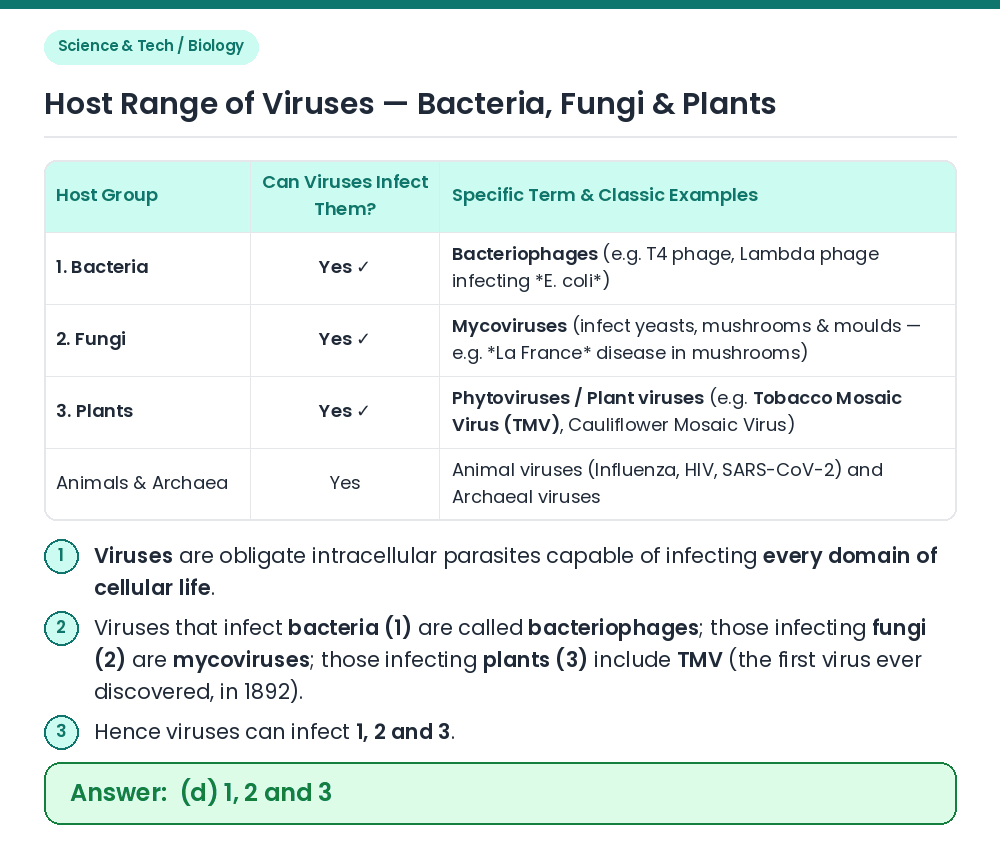
Which of the following statements is/are correct? Viruses can infect 1. bacteria 2. fungi 3. plants Select the correct answer using the code given below.
Show answer & explanationShow explanation
Answer: (D) 1, 2 and 3
Concept: Viruses are sub-microscopic, acellular infectious agents (consisting of DNA or RNA enclosed in a protein coat called a capsid) that replicate only inside living host cells. Hosts 1, 2 & 3: Viruses infect all types of cellular organisms — bacteria (via bacteriophages, 1 is correct), fungi (via mycoviruses, 2 is correct), and plants (via phytoviruses such as Tobacco Mosaic Virus, 3 is correct), as well as animals and archaea. Result: Thus, viruses can infect all three — bacteria, fungi, and plants. Related Facts: • Discovery of Viruses: Dmitri Ivanovsky (1892) and Martinus Beijerinck (1898) discovered the first virus — Tobacco Mosaic Virus (TMV), a plant RNA virus. • Bacteriophages: Discovered independently by Frederick Twort (1915) and Félix d'Hérelle (1917); they normally contain double-stranded DNA. • Virophages: Some satellite viruses (like Sputnik virophage) can even parasitize giant viruses (Mimivirus). Correct Answer: (d) 1, 2 and 3