Civil Services Examination · Question 65
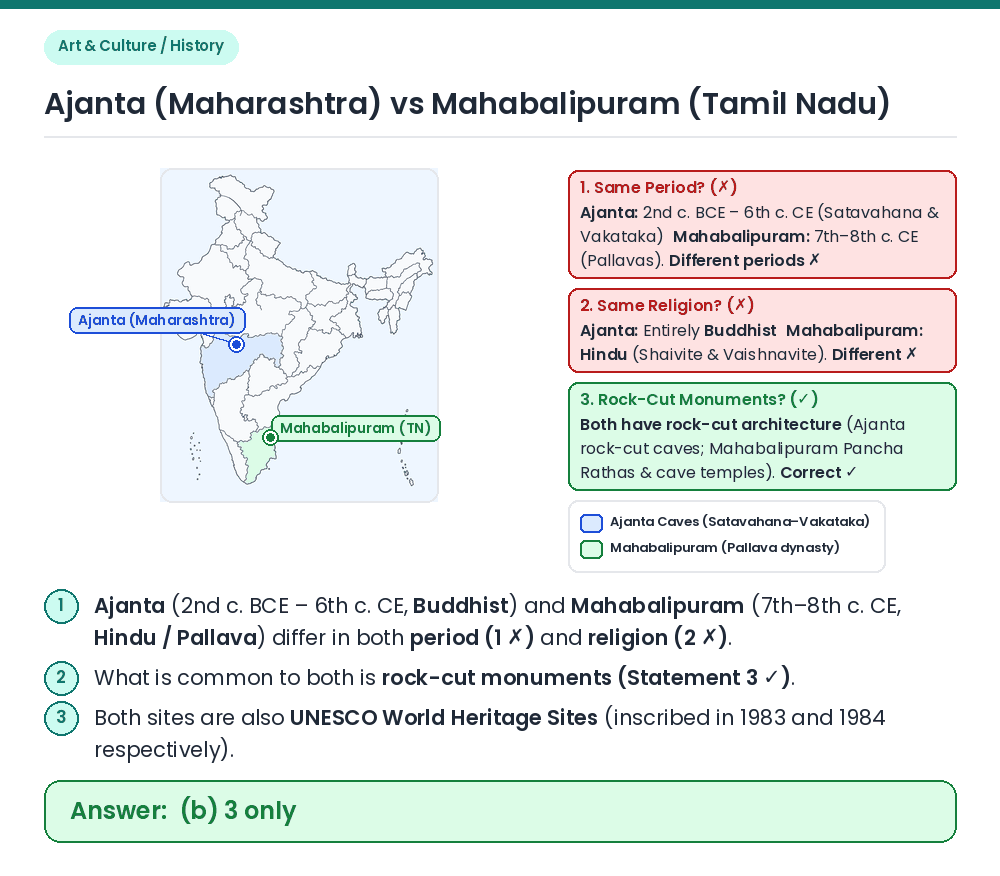
What is/are common to the two historical places known as Ajanta and Mahabalipuram? 1. Both were built in the same period. 2. Both belong to the same religious denomination. 3. Both have rock-cut monuments. Select the correct answer using the code given below.
Show answer & explanationShow explanation
Answer: (B) 3 only
Concept: Ajanta (in Chhatrapati Sambhajinagar/Aurangabad district, Maharashtra) and Mahabalipuram/Mamallapuram (in Chengalpattu district, Tamil Nadu) are two landmark sites of Indian art and architecture. Statements 1 & 2: Ajanta caves were excavated in two phases between the 2nd century BCE and 5th–6th century CE (Satavahana and Vakataka patronage) and are entirely Buddhist; Mahabalipuram was built later in the 7th–8th centuries CE under the Pallavas (Narasimhavarman I and Rajasimha) and belongs to the Hindu religious tradition ⇒ Statements 1 and 2 are incorrect. Statement 3: Both sites feature magnificent rock-cut monuments — 29 rock-cut Chaityas and Viharas carved into the Waghora basalt cliff at Ajanta, and monolithic rock-cut Rathas (Pancha Rathas), rock-cut mandapas, and open-air rock reliefs at Mahabalipuram ⇒ Statement 3 is correct. Result: Only Statement 3 is correct. Related Facts: • Ajanta Patronage: Cave 16 was patronized by Varahadeva (minister of Vakataka king Harishena) and Cave 17 by a feudatory prince; famous for fresco/tempera murals (Padmapani, Vajrapani). • Mahabalipuram Monuments: Includes the monolithic Pancha Rathas, rock-cut cave mandapas, Descent of the Ganges / Arjuna's Penance relief, and the structural Shore Temple. • Ellora Contrast: Unlike Ajanta (Buddhist only), Ellora Caves (5th–11th century CE) contain Buddhist, Brahmanical (Hindu), and Jain rock-cut monuments. Correct Answer: (b) 3 only