Civil Services Examination · Question 83
Which of the following is/are the advantage/advantages of practising drip irrigation? 1. Reduction in weed 2. Reduction in soil salinity 3. Reduction in soil erosion Select the correct answer using the code given below.
Show answer & explanationShow explanation
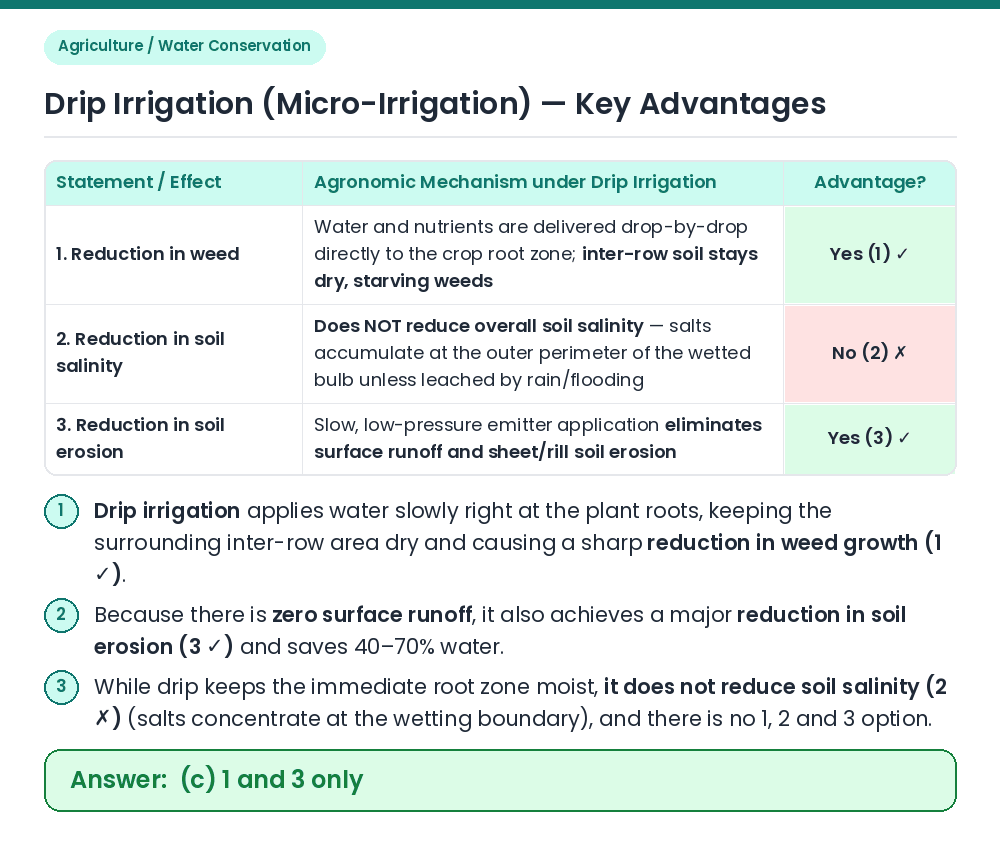
Answer: (C) 1 and 3 only
Concept: Drip irrigation (trickle micro-irrigation) delivers water and soluble nutrients ('fertigation') drop by drop through emitters directly to the plant root zone at low pressure. Advantage 1 — Reduction in weed: Because water is applied only at the base of the crop and the inter-row spaces remain dry, weed seeds between crop rows do not germinate ⇒ Reduction in weed (1) is a major advantage. Advantage 3 — Reduction in soil erosion: Since water is applied at a slow trickle matching the soil's infiltration rate, there is zero surface runoff, completely preventing sheet and rill erosion ⇒ Reduction in soil erosion (3) is a major advantage. Statement 2 — Soil salinity: While drip irrigation keeps the immediate root zone moist so crops can tolerate slightly saline water, it does not reduce overall soil salinity — in fact, dissolved salts accumulate at the outer edge of the wetting front unless periodically leached by rain or flood irrigation (and note that there is no '1, 2 and 3' option) ⇒ Statement 2 is excluded. Result: Only 1 and 3 are correct advantages. Related Facts: • PMKSY Scheme: Under the Pradhan Mantri Krishi Sinchayee Yojana (PMKSY), the 'Per Drop More Crop' component specifically promotes drip and sprinkler micro-irrigation. • Water Efficiency: Drip irrigation achieves 85–95% water-use efficiency compared to 30–40% in conventional flood irrigation. Correct Answer: (c) 1 and 3 only