Civil Services Examination · Question 88
With reference to the economic history of medieval India, the term 'Araghatta' refers to
Show answer & explanationShow explanation
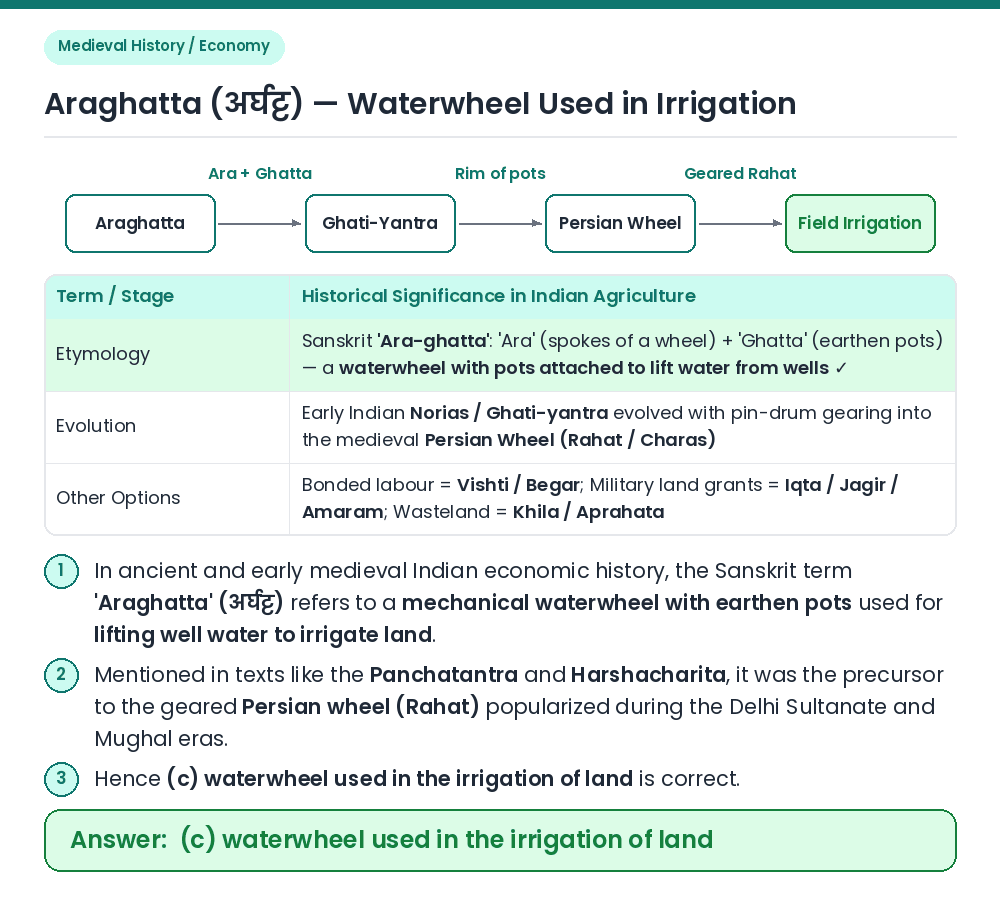
Answer: (C) waterwheel used in the irrigation of land
Concept: In ancient and early medieval Indian agrarian history, 'Araghatta' (or 'Ghati-yantra') was a mechanical water-lifting device used for well irrigation. Etymology and Meaning: The Sanskrit word 'Araghatta' combines 'Ara' (spokes of a wheel) and 'Ghatta' (earthen pots) — referring to a wheel with a garland of earthen pots attached to its rim or chain to lift water from wells for irrigating fields ⇒ Option (c) is correct. Compare with Other Terms: Bonded/forced labour was called 'Vishti'; military land assignments were called 'Iqta' (Sultanate), 'Jagir' (Mughal), or 'Amaram' (Vijayanagara); uncultivated wasteland was called 'Khila' or 'Aprahata'. Result: 'Araghatta' refers to a waterwheel used in the irrigation of land. Related Facts: • Literary References: Banabhatta's Harshacharita (7th century CE) and the Panchatantra vividly mention the Araghatta / Ghati-yantra irrigating fields. • Technological Evolution: With the later addition of a pin-drum gearing mechanism and animal power during the medieval period, the Araghatta evolved into the geared 'Persian wheel' (Rahat or Saqiya). Correct Answer: (c) waterwheel used in the irrigation of land