Civil Services Examination · Question 95
The Parliament of India acquires the power to legislate on any item in the State List in the national interest if a resolution to that effect is passed by the
Show answer & explanationShow explanation
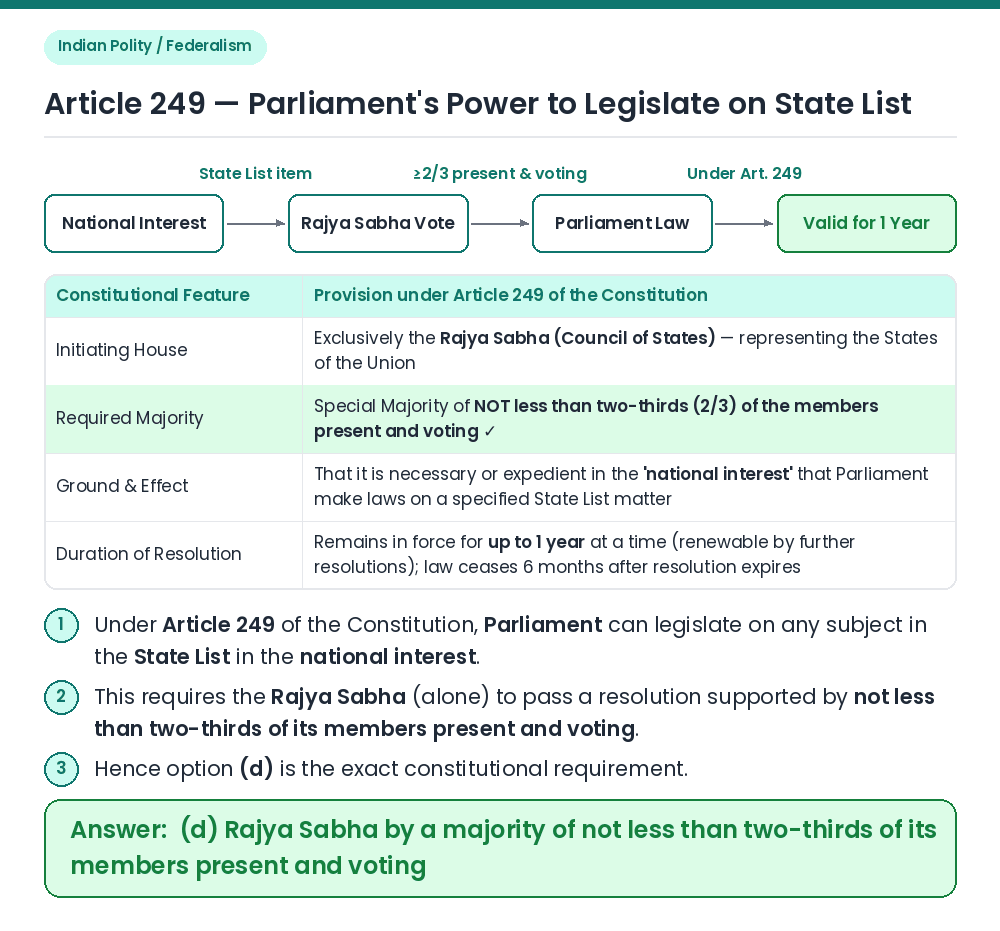
Answer: (D) Rajya Sabha by a majority of not less than two-thirds of its members present and voting
Concept: Under Article 249 of the Constitution of India (Part XI — Relations between the Union and the States), the Rajya Sabha is vested with the special federal power to authorize Parliament to legislate on a State List subject in the national interest. Constitutional Requirement under Article 249: If the Council of States (Rajya Sabha) declares by a resolution supported by not less than two-thirds (2/3) of the members present and voting that it is necessary or expedient in the national interest that Parliament should make laws with respect to any matter enumerated in the State List, Parliament becomes empowered to make laws on that subject ⇒ Option (d) is correct. Duration of Resolution: Such a resolution remains in force for a period not exceeding 1 year (renewable for 1 year at a time by another resolution), and a law made under it ceases to have effect 6 months after the resolution expires. Result: The resolution must be passed by the Rajya Sabha by a majority of not less than two-thirds of its members present and voting. Related Facts: • Article 312 Comparison: Similarly, under Article 312, the Rajya Sabha can authorize Parliament to create new All-India Services by passing a resolution supported by not less than two-thirds of the members present and voting. • Other State List Grounds: Parliament can also legislate on the State List during a National Emergency (Article 250), request by two or more States (Article 252), implementation of international treaties (Article 253), and President's Rule (Article 356). Correct Answer: (d) Rajya Sabha by a majority of not less than two-thirds of its members present and voting