Civil Services Examination · Question 41
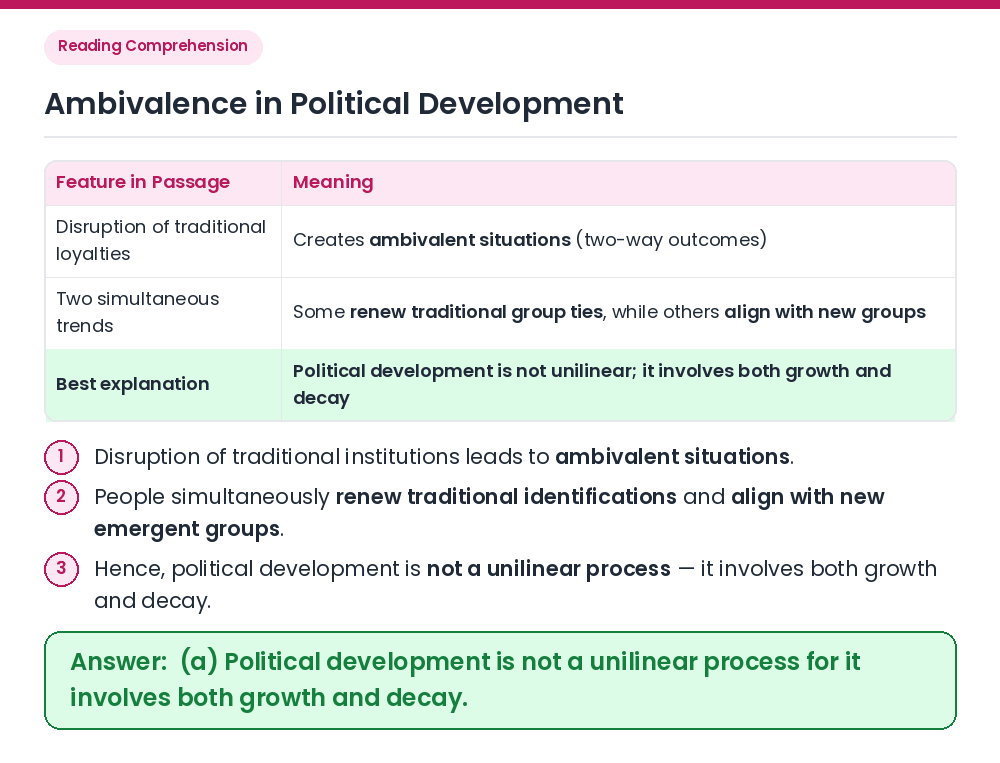
Directions for the following 8 (eight) items : Read the following seven passages and answer the items that follow the passages. Your answers to these items should be based on the passages only. Passage—1 Disruption of traditional institutions, identifications and loyalties is likely to lead to ambivalent situations. It is possible that some people may renew their identification with traditional groups whereas others align themselves with new groups and symbols emergent from processes of political development. In addition, political development tends to foster group awareness of a variety of class, tribe, region, clan, language, religion, occupation and others. Which one of the following is the best explanation of the above passage?
Show answer & explanationShow explanation
Answer: (A) Political development is not a unilinear process for it involves both growth and decay.
Concept: The passage explains that political development creates 'ambivalent' (two-way) situations where traditional identifications are simultaneously disrupted and renewed alongside new groups. Passage Analysis: Because some people align with new symbols while others renew traditional clan/tribe/caste loyalties, political development does not move in a single straight line. Elimination: (b), (c) and (d) make one-sided or extreme claims ('succeed in resisting', 'impossible', 'conducive') that miss the core 'ambivalent' nature. Result: Political development is not a unilinear process for it involves both growth and decay. Correct Answer: (a) Political development is not a unilinear process for it involves both growth and decay.