Civil Services Examination · Question 61
Directions for the following 7 (seven) items : Read the following seven passages and answer the items that follow the passages. Your answers to these items should be based on the passages only. Passage—1 An air quality index (AQI) is a way to combine measurements of multiple air pollutants into a single number or rating. This index is ideally kept constantly updated and available in different places. The AQI is most useful when lots of pollution data are being gathered and when pollution levels are normally, but not always, low. In such cases, if pollution levels spike for a few days, the public can quickly take preventive action (like staying indoors) in response to an air quality warning. Unfortunately, that is not urban India. Pollution levels in many large Indian cities are so high that they remain well above any health or regulatory standard for large part of the year. If our index stays in the 'Red/Dangerous' region day after day, there is not much any one can do, other than getting used to ignoring it. Which among the following is the most logical and rational inference that can be made from the above passage?
Show answer & explanationShow explanation
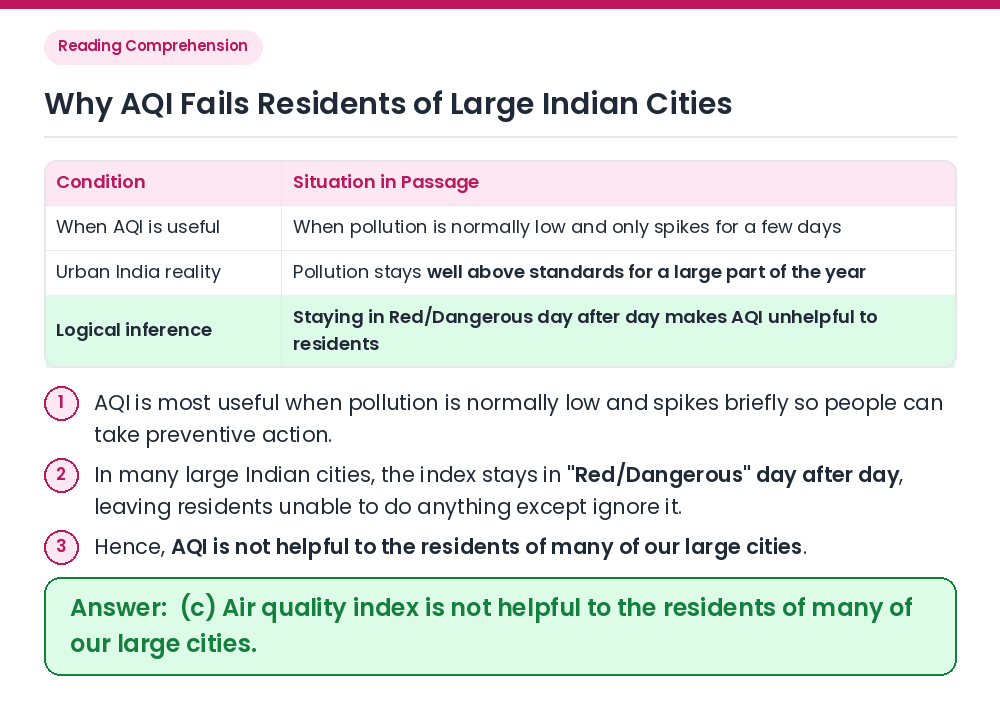
Answer: (C) Air quality index is not helpful to the residents of many of our large cities.
Concept: The passage explains when AQI is useful (normally low pollution with brief spikes) versus why it fails in urban India (chronic high pollution). Passage Analysis: Because pollution in many large Indian cities stays in the 'Red/Dangerous' zone day after day, residents cannot take short-term preventive action and end up ignoring it. Elimination: (a) blames governments (not in text); (b) 'absolutely no need' is too extreme; (d) public awareness is not the issue discussed. Result: Air quality index is not helpful to the residents of many of our large cities. Correct Answer: (c) Air quality index is not helpful to the residents of many of our large cities.