Civil Services Examination · Question 73
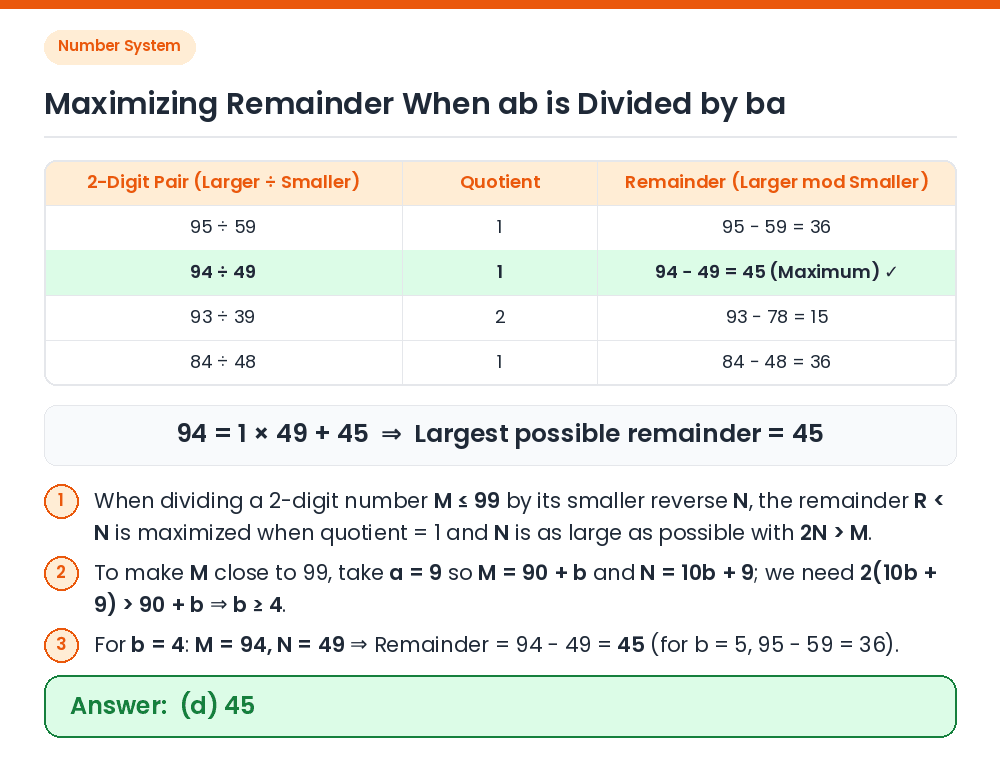
A 2-digit number is reversed. The larger of the two numbers is divided by the smaller one. What is the largest possible remainder?
Show answer & explanationShow explanation
Answer: (D) 45
Concept: Let the larger 2-digit number be M = 10a + b and its reversed smaller number be N = 10b + a (with a > b ≥ 1). Remainder R < N is maximized when quotient = 1, so R = M − N = 9(a − b) with M < 2N. Maximize a − b: Since R = 9(a − b), to maximize R we want (a − b) as large as possible subject to 10a + b < 2(10b + a) ⇒ 8a < 19b. Test Largest a = 9: For a = 9, 8(9) = 72 < 19b ⇒ b ≥ 4. Taking the smallest valid b = 4 maximizes (a − b) = 9 − 4 = 5 ⇒ M = 94, N = 49. Result: Dividing 94 by 49 gives quotient 1 and largest possible remainder R = 94 − 49 = 45. Shortcut: Remainder when quotient is 1 equals M − N = 9(a − b), which must be a multiple of 9; testing the largest option 45 gives a − b = 5 → 94 ÷ 49 = 1 R 45 ✓. Correct Answer: (d) 45