Civil Services Examination · Question 2
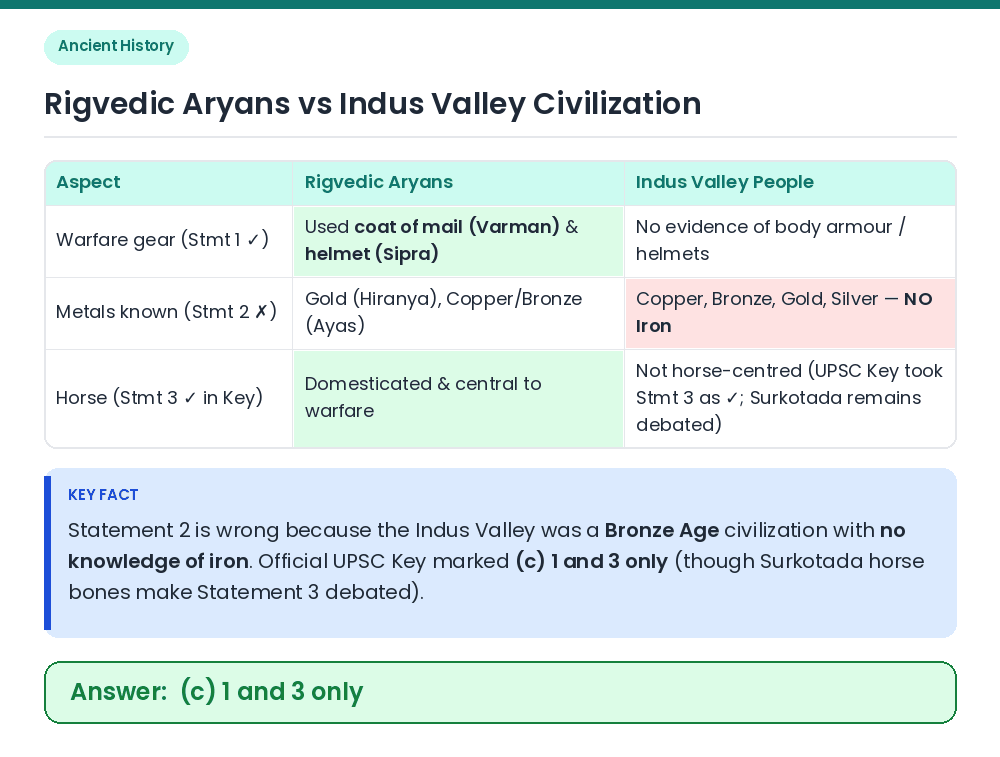
With reference to the difference between the culture of Rigvedic Aryans and Indus Valley people, which of the following statements is/are correct ? 1. Rigvedic Aryans used the coat of mail and helmet in warfare whereas the people of Indus Valley Civilization did not leave any evidence of using them. 2. Rigvedic Aryans knew gold, silver and copper whereas Indus Valley people knew only copper and iron. 3. Rigvedic Aryans had domesticated the horse whereas there is no evidence of Indus Valley people having been aware of this animal. Select the correct answer using the code given below :
Show answer & explanationShow explanation
Answer: (C) 1 and 3 only
Concept: Compare material culture and archaeological evidence of the Bronze Age Indus Valley Civilization (IVC) and the Rigvedic period. Evaluate Statement 1: Rigvedic texts mention coats of mail (varman) and helmets (sipra), whereas IVC excavations show no armour or helmets ⇒ Statement 1 is correct. Evaluate Statement 2: IVC was a Chalcolithic/Bronze Age culture that knew copper, bronze, silver and gold, but did NOT know iron (Iron Age began around 1000 BCE) ⇒ Statement 2 is incorrect. Evaluate Statement 3 & Key Note: In mainstream NCERT textbook accounts (R.S. Sharma's Ancient India), the Indus Valley culture was not horse-centred and had no conclusive evidence of true horse domestication, so the official UPSC answer key treated Statement 3 as correct and gave (c) 1 and 3 only (note: because jawbones/teeth reported at Surkotada and terracotta figurines at Lothal are cited by some archaeologists, Statement 3 is considered debatable, making (a) 1 only a close contender). Result: Statements 1 and 3 are correct as per the official UPSC key. Related Facts: • Metal in Rigveda: The term 'Ayas' in Rigveda denoted copper or bronze; 'Shyama Ayas' or 'Krishna Ayas' in later Vedic texts denoted iron. • Surkotada: Excavated by J.P. Joshi in Kutch, Gujarat. Correct Answer: (c) 1 and 3 only