Civil Services Examination · Question 24
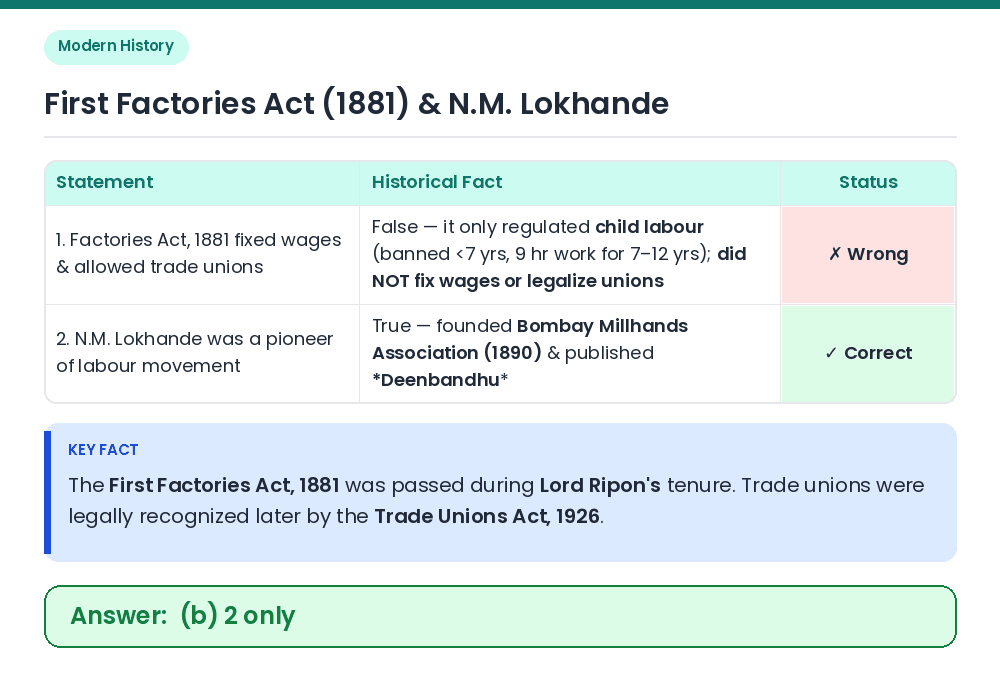
Consider the following statements : 1. The Factories Act, 1881 was passed with a view to fix the wages of industrial workers and to allow the workers to form trade unions. 2. N.M. Lokhande was a pioneer in organizing the labour movement in British India. Which of the above statements is/are correct ?
Show answer & explanationShow explanation
Answer: (B) 2 only
Concept: Examine early labour legislation and trade union pioneers in 19th-century British India. Evaluate Statement 1: The First Factories Act, 1881 (passed under Viceroy Lord Ripon) focused primarily on child labour (prohibiting employment of children under 7 years and limiting working hours to 9 hours/day for children aged 7–12); it did NOT fix wages or allow workers to form trade unions ⇒ Statement 1 is incorrect. Evaluate Statement 2: Narayan Meghaji Lokhande (an associate of Jyotirao Phule) organized the Bombay Millhands Association in 1890 and edited the Marathi labour journal 'Deenbandhu', making him the father of the Indian trade union movement ⇒ Statement 2 is correct. Result: Only statement 2 is correct. Related Facts: • Second Factories Act (1891): Passed during Lord Lansdowne's tenure; N.M. Lokhande's agitation helped secure a weekly Sunday holiday for mill workers. • Minimum Wages: The Minimum Wages Act in India was enacted much later in 1948. Correct Answer: (b) 2 only