Civil Services Examination · Question 62
In the context of Indian history, the principle of 'Dyarchy (diarchy)' refers to (a) Division of the central legislature into two houses. (b) Introduction of double government i.e., Central and State governments. (c) Having two sets of rulers; one in London and another in Delhi. (d) Division of the subjects delegated to the provinces into two categories.
Show answer & explanationShow explanation
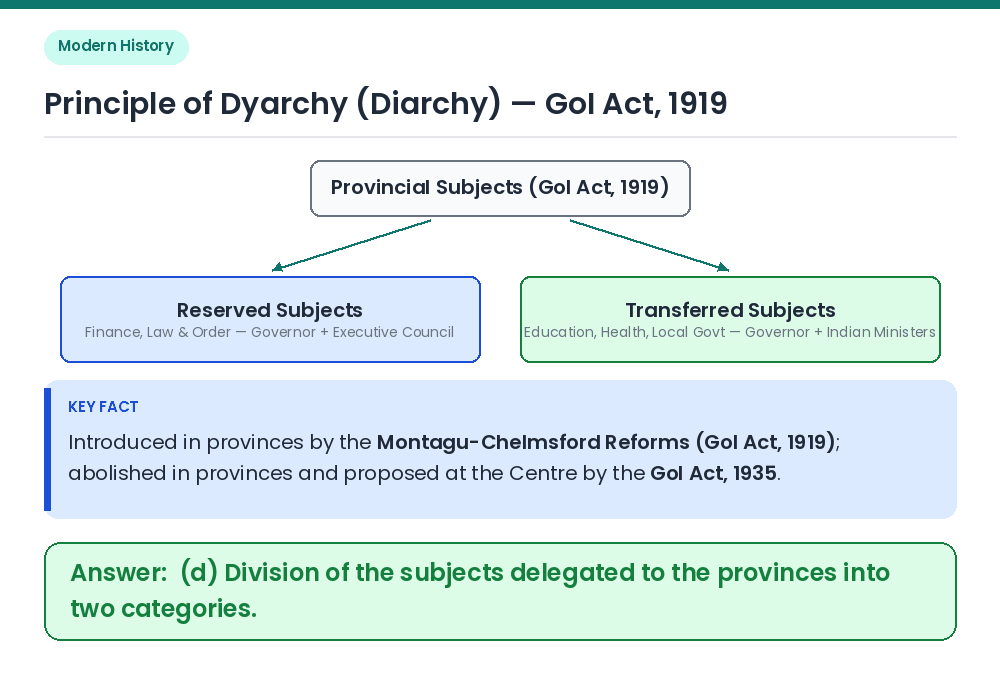
Answer: (D) Division of the subjects delegated to the provinces into two categories.
Concept: Dyarchy (from Greek 'di-archia', rule by two) was introduced in British Indian provinces by the Government of India Act, 1919 (Montagu-Chelmsford Reforms). Explain provincial dyarchy: It divided the provincial list of subjects into two categories — 'Reserved Subjects' (like police, justice, finance, irrigation, administered by the Governor and his non-responsible Executive Council) and 'Transferred Subjects' (like education, public health, agriculture, local self-government, administered by the Governor acting with Indian Ministers responsible to the Legislative Council). Result: Dyarchy refers to the division of the subjects delegated to the provinces into two categories. Related Facts: • Coined by: Lionel Curtis (author of the book 'Dyarchy') is regarded as the father of the idea of dyarchy in India. • GoI Act 1935: Abolished dyarchy in the provinces (introducing Provincial Autonomy) and provided for dyarchy at the Centre. Correct Answer: (d) Division of the subjects delegated to the provinces into two categories.