Civil Services Examination · Question 86
Right to vote and to be elected in India is a (a) Fundamental Right (b) Natural Right (c) Constitutional Right (d) Legal Right
Show answer & explanationShow explanation
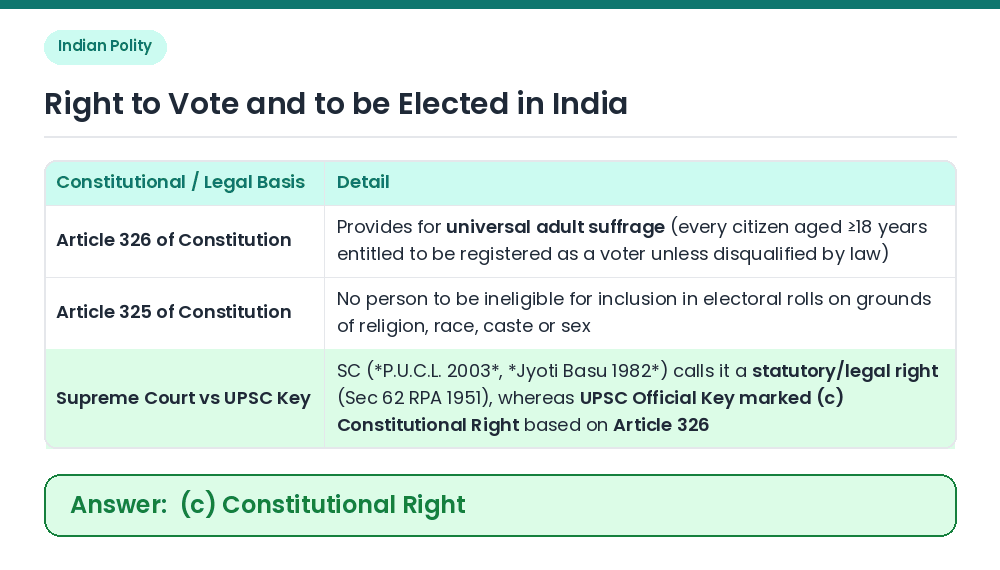
Answer: (C) Constitutional Right
Concept: Examine the constitutional and statutory provisions governing the right to vote and to be elected in India (Articles 325–326 of the Constitution and Sections 62 & 3–6 of the Representation of the People Act, 1951). Constitutional Basis — Article 326: Article 326 of the Constitution explicitly provides that elections to the Lok Sabha and State Legislative Assemblies shall be on the basis of adult suffrage; based on this direct textual guarantee in Part XV of the Constitution, UPSC's official answer key declared it a 'Constitutional Right' (Option c). Note on Judicial View vs Official Key: Note that in several judgments (such as Jyoti Basu v. Debi Ghosal, 1982; Kuldip Nayar v. Union of India, 2006; and recently Anoop Baranwal v. Union of India, 2023), the Supreme Court distinguished between the constitutional mandate of adult suffrage (Art. 326) and the actual right to vote/contest regulated by the Representation of the People Act, 1951 (calling it a statutory/legal right, or in Justice Rastogi's 2023 concurrence a constitutional right). Following the official UPSC key, (c) Constitutional Right is retained. Result: Right to vote and to be elected in India is a Constitutional Right (as per UPSC official key). Related Facts: • 61st Constitutional Amendment Act (1988): Reduced the voting age under Article 326 from 21 years to 18 years (came into force in 1989). Correct Answer: (c) Constitutional Right