Civil Services Examination · Question 30
Passage—2 A diversity of natural assets will be needed to cope with climate change and ensure productive agriculture, forestry, and fisheries. For example, crop varieties are needed that perform well under drought, heat, and enhanced CO₂. But the private-sector and farmer-led process of choosing crops favours homogeneity adapted to past or current conditions, not varieties capable of producing consistently high yields in warmer, wetter, or drier conditions. Accelerated breeding programmes are needed to conserve a wider pool of genetic resources of existing crops, breeds, and their wild relatives. Relatively intact ecosystems, such as forested catchments, mangroves, wetlands, can buffer the impacts of climate change. Under a changing climate, these ecosystems are themselves at risk, and management approaches will need to be more proactive and adaptive. Connections between natural areas, such as migration corridors, may be needed to facilitate species movements to keep up with the change in climate. With reference to the above passage, which of the following would assist us in coping with the climate change? 1. Conservation of natural water sources 2. Conservation of wider gene pool 3. Existing crop management practices 4. Migration corridors Select the correct answer using the code given below.
Show answer & explanationShow explanation
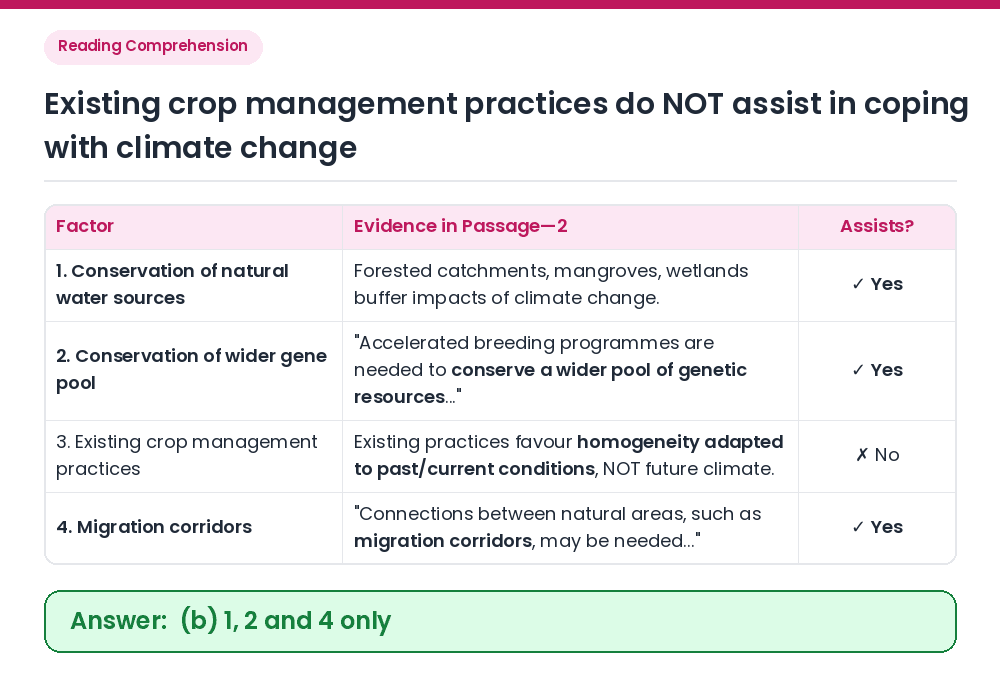
Answer: (B) 1, 2 and 4 only
Given: Passage—2 outlining ecological and genetic measures needed to cope with climate change. Check 1, 2, and 4: The passage explicitly supports conserving 'forested catchments, mangroves, wetlands' (natural water sources = 1), conserving 'a wider pool of genetic resources' (wider gene pool = 2), and creating 'migration corridors' (4). Check 3: The passage criticizes existing crop selection/management practices because they favour 'homogeneity adapted to past or current conditions' rather than climate-resilient varieties, and says management approaches need to change. Conclusion: Eliminate 3; 1, 2 and 4 only is correct. Correct Answer: (b) 1, 2 and 4 only