Civil Services Examination · Question 16
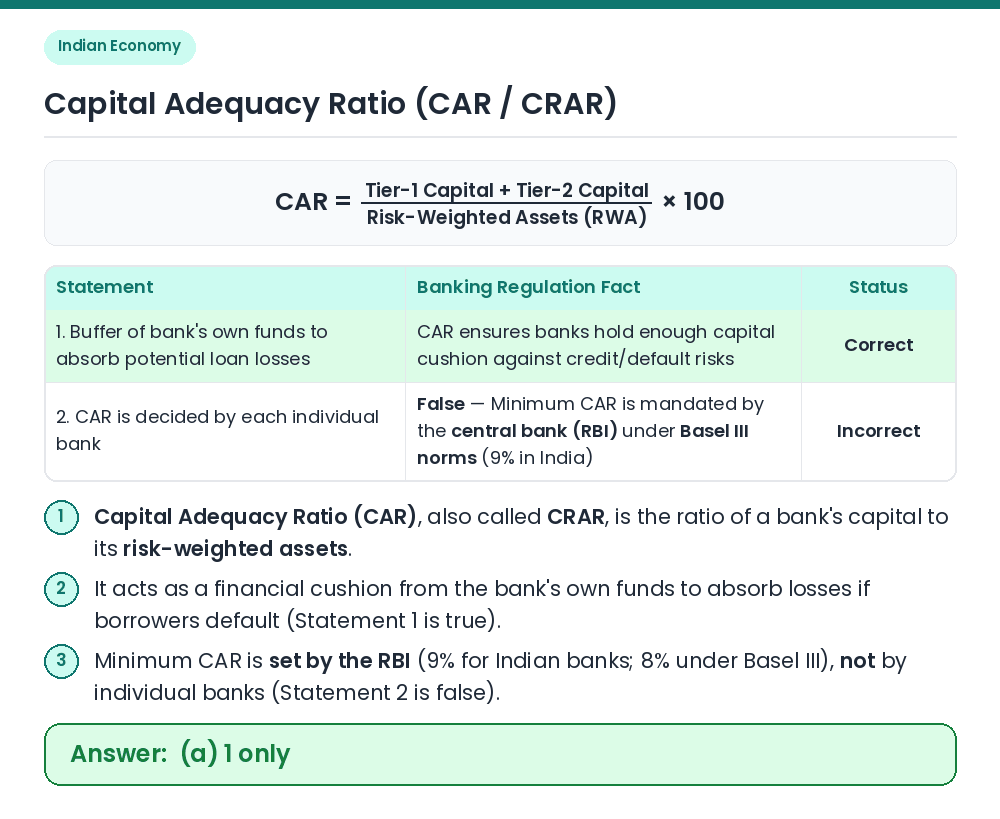
Consider the following statements : 1. Capital Adequacy Ratio (CAR) is the amount that banks have to maintain in the form of their own funds to offset any loss that banks incur if the account-holders fail to repay dues. 2. CAR is decided by each individual bank. Which of the statements given above is/are correct ?
Show answer & explanationShow explanation
Answer: (A) 1 only
Concept: Meaning and regulatory authority for Capital Adequacy Ratio (CAR), also known as Capital to Risk-Weighted Assets Ratio (CRAR). Statement 1: CAR = (Tier 1 Capital + Tier 2 Capital) ÷ Risk-Weighted Assets; it represents the capital cushion banks must maintain from their own funds to absorb losses when borrowers/loan account-holders fail to repay dues ⇒ Statement 1 is correct. Statement 2: CAR is not decided by each individual bank; the minimum CAR threshold is mandated by the central bank (Reserve Bank of India) in line with Basel Committee norms ⇒ Statement 2 is incorrect. Result: Only statement 1 is correct, making option (a) the right answer. Related Facts: • RBI vs Basel III Norm: While Basel III prescribes a minimum CAR of 8% (excluding Capital Conservation Buffer), the RBI mandates a minimum CAR of 9% for Indian scheduled commercial banks (and 15% for NBFCs/RRBs/Small Finance Banks). • Tier-1 vs Tier-2 Capital: Tier-1 capital (core equity and disclosed reserves) can absorb losses without a bank ceasing trading, whereas Tier-2 capital (subordinated debt, revaluation reserves) absorbs losses in the event of winding up. • Note on Wording: Strictly speaking, loan borrowers default on dues (labelled 'account-holders' in the question text), which is why Statement 1 is treated as correct by UPSC. Correct Answer: (a) 1 only