Civil Services Examination · Question 50
If you withdraw ₹ 1,00,000 in cash from your Demand Deposit Account at your bank, the immediate effect on aggregate money supply in the economy will be
Show answer & explanationShow explanation
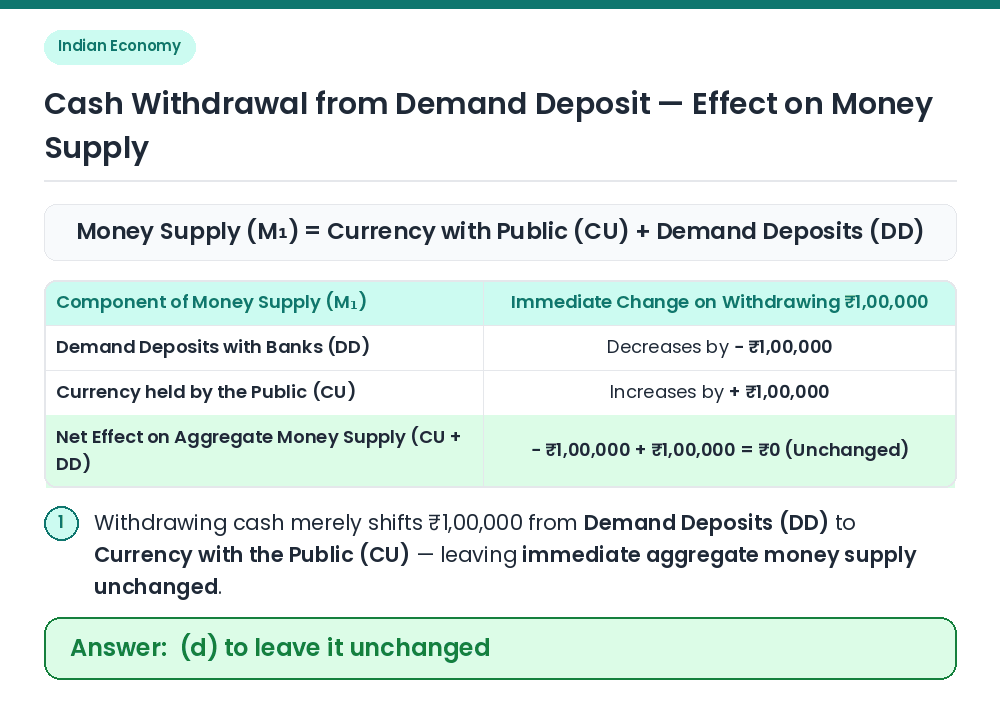
Answer: (D) to leave it unchanged
Given / Concept: Formula for Aggregate Money Supply: M₁ = CU (Currency with the Public) + DD (Demand Deposits with Banks) + OD (Other Deposits with RBI). Compute Component Changes: When you withdraw ₹1,00,000 in cash from your Demand Deposit Account: ⇒ Demand Deposits (DD) decrease by ₹1,00,000 (−₹1,00,000) ⇒ Currency with the Public (CU) increases by ₹1,00,000 (+₹1,00,000). Net Immediate Effect: ΔM₁ = ΔCU + ΔDD = (+₹1,00,000) + (−₹1,00,000) = ₹0 ⇒ Aggregate money supply remains unchanged immediately. Result: The immediate effect on aggregate money supply is to leave it unchanged. Related Facts: • Shortcut: Both cash in hand (CU) and bank demand deposits (DD) are part of money supply; moving money from one pocket (bank account) to another (wallet) does not change the total. • Long-run Credit Multiplier Effect: Over time (not immediately), lower bank reserves reduce the banking system's credit creation capacity. Correct Answer: (d) to leave it unchanged