Civil Services Examination · Question 91
What are the advantages of fertigation in agriculture? 1. Controlling the alkalinity of irrigation water is possible. 2. Efficient application of Rock Phosphate and all other phosphatic fertilizers is possible. 3. Increased availability of nutrients to plants is possible. 4. Reduction in the leaching of chemical nutrients is possible. Select the correct answer using the code given below :
Show answer & explanationShow explanation
Answer: (C) 1, 3 and 4 only
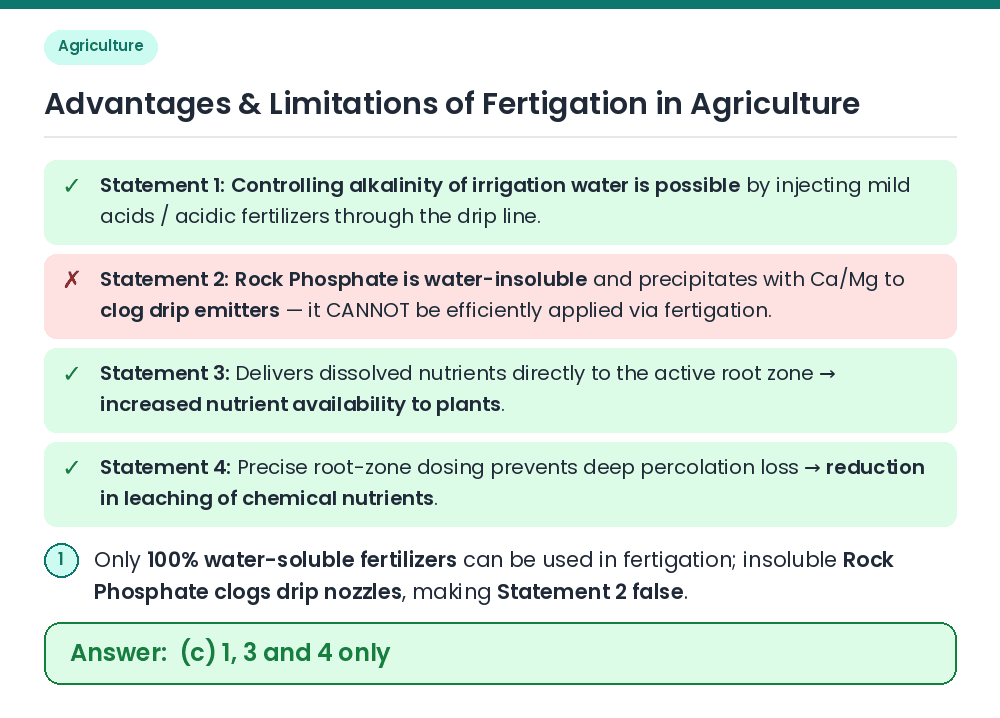
Given / Concept: Principles of Fertigation (injecting water-soluble fertilizers into a drip/micro-irrigation system, as detailed in TNAU Agritech Portal). Eliminate Statement 2: Fertigation requires completely water-soluble fertilizers; Rock Phosphate is insoluble in water, and standard phosphatic fertilizers react with calcium and magnesium ions in irrigation water to form insoluble precipitates (calcium phosphate) that clog drip emitters ⇒ Statement 2 ('Rock Phosphate and all other phosphatic fertilizers') is incorrect. Verify Statements 1, 3 & 4: Injecting nitric/phosphoric acid or acidic fertilizers controls irrigation water alkalinity and prevents scaling (⇒ Statement 1 is correct); applying nutrients directly to the root zone boosts nutrient uptake efficiency to 80%–90% (⇒ Statement 3 is correct) and minimizes downward leaching of nitrates/chemicals into groundwater (⇒ Statement 4 is correct). Result: Advantages are 1, 3 and 4 only. Related Facts: • Elimination Shortcut: Eliminating Statement 2 ('Rock Phosphate and ALL other phosphatic fertilizers') immediately eliminates options (a), (b), and (d), leaving only (c)! • Suitable Fertigation Fertilizers: Urea, Potash (MOP/SOP), Mono-Ammonium Phosphate (MAP), and Urea Phosphate. Correct Answer: (c) 1, 3 and 4 only