Civil Services Examination · Question 11
Read the following passage and answer the item that follows. Your answer to this item should be based on the passage only. Passage – 1 Fig trees (genus Ficus) are considered sacred in India, East Asia and Africa and are common in agricultural and urban landscapes where other large trees are absent. In natural forests, fig trees provide food for wildlife when other resources are scarce and support a high density and diversity of frugivores (fruit-eating animals). If frugivorous birds and bats continue to visit fig trees located in sites with high human disturbance, sacred fig trees may promote frugivore abundance. Under favourable microclimate, plenty of seedlings of other tree species would grow around fig trees. On the basis of the passage given above, the following assumptions have been made : 1. Fig trees can often be keystone species in natural forests. 2. Fig trees can grow where other large woody species cannot grow. 3. Sacred trees can have a role in biodiversity conservation. 4. Fig trees have a role in the seed dispersal of other tree species. Which of the above assumptions is/are valid?
Show answer & explanationShow explanation
Answer: (D) 1, 3 and 4 only
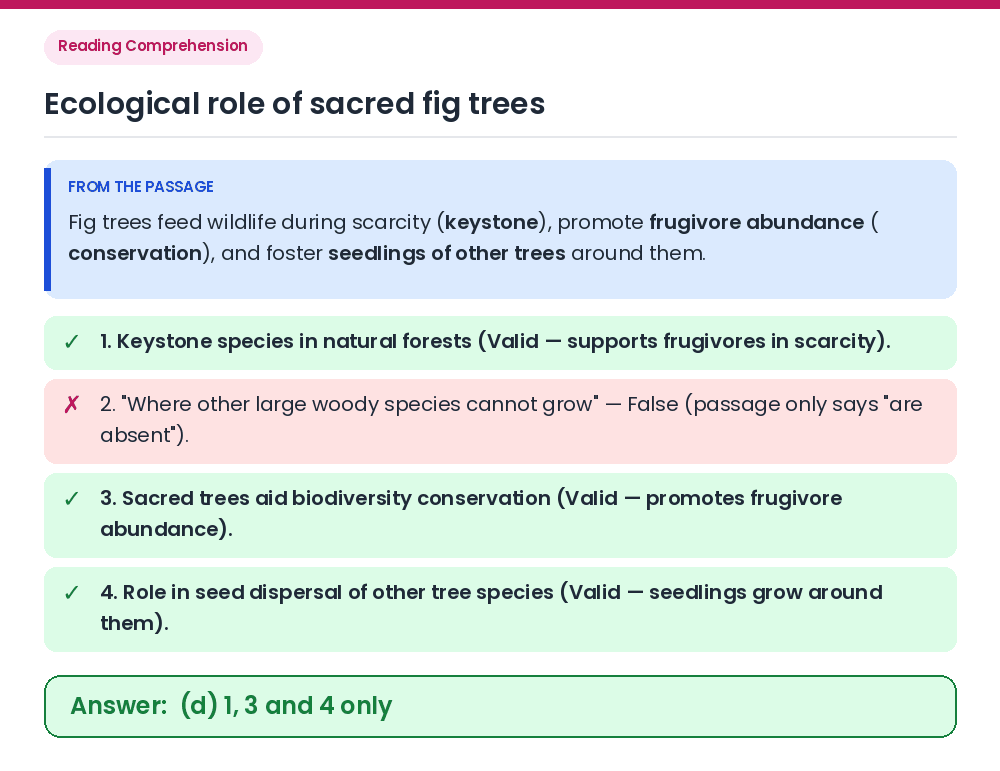
Given / Concept: Check each assumption against the ecological role of sacred fig trees in the passage. Check 1 & 3: Fig trees provide food when other resources are scarce and support a high density/diversity of frugivores ⇒ they act as keystone species (1 valid) and sacred fig trees conserve biodiversity (3 valid). Check 2 & 4: The passage says fig trees are common where other large trees "are absent" (due to human/urban preference as sacred trees), NOT that other woody species "cannot grow" there biologically (2 invalid). Frugivorous birds/bats visiting fig trees bring seeds, so seedlings of other tree species grow around them (4 valid). Result: Assumptions 1, 3 and 4 are valid. Correct Answer: (d) 1, 3 and 4 only