Civil Services Examination · Question 33
Read the following passage and answer the item that follows. Your answer to this item should be based on the passage only. Passage – 3 Inequality violates a basic democratic norm : the equal standing of citizens. Equality is a relation that obtains between persons in respect of some fundamental characteristic that they share in common. Equality is, morally speaking, a default principle. Therefore, persons should not be discriminated on grounds such as race, caste, gender, ethnicity, disability, or class. These features of human condition are morally irrelevant. The idea that one should treat persons with respect not only because some of these persons possess some special features or talent, for example skilled cricketers, gifted musicians, or literary giants, but because persons are human beings, is by now part of commonsense morality. With reference to the above passage, the following assumptions have been made : 1. Equality is a prerequisite for people to participate in the multiple transactions of society from a position of confidence. 2. Occurrence of inequality is detrimental to the survival of democracy. 3. Equal standing of all citizens is an idea that cannot actually be realised even in a democracy. 4. Right to equality should be incorporated into our values and day-to-day political vocabulary. Which of the above assumptions are valid?
Show answer & explanationShow explanation
Answer: (C) 1 and 4 only
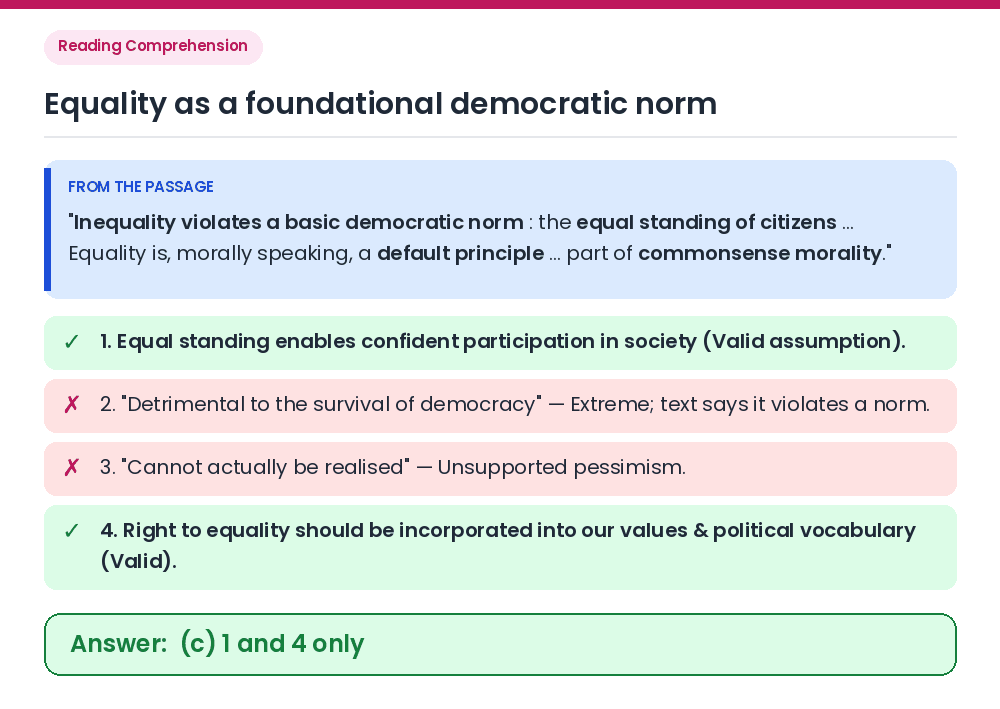
Given / Concept: "Inequality violates a basic democratic norm: the equal standing of citizens", and equality is a default moral principle where persons should not be discriminated against. Validate 1 & 4: Equal standing and non-discrimination enable citizens to participate in society from a position of confidence (1 valid), and treating equality as a default moral and democratic norm implies incorporating the right to equality into our values and political vocabulary (4 valid). Eliminate 2 & 3: The passage says inequality violates a democratic norm, not that any occurrence of inequality threatens the very "survival of democracy" (2 is extreme); Statement 3 is pessimistic and unsupported. Result: Assumptions 1 and 4 only are valid. Correct Answer: (c) 1 and 4 only