Civil Services Examination · Question 54
Let A, B and C represent distinct non-zero digits. Suppose x is the sum of all possible 3-digit numbers formed by A, B and C without repetition. Consider the following statements : 1. The 4-digit least value of x is 1332. 2. The 3-digit greatest value of x is 888. Which of the above statements is/are correct?
Show answer & explanationShow explanation
Answer: (A) 1 only
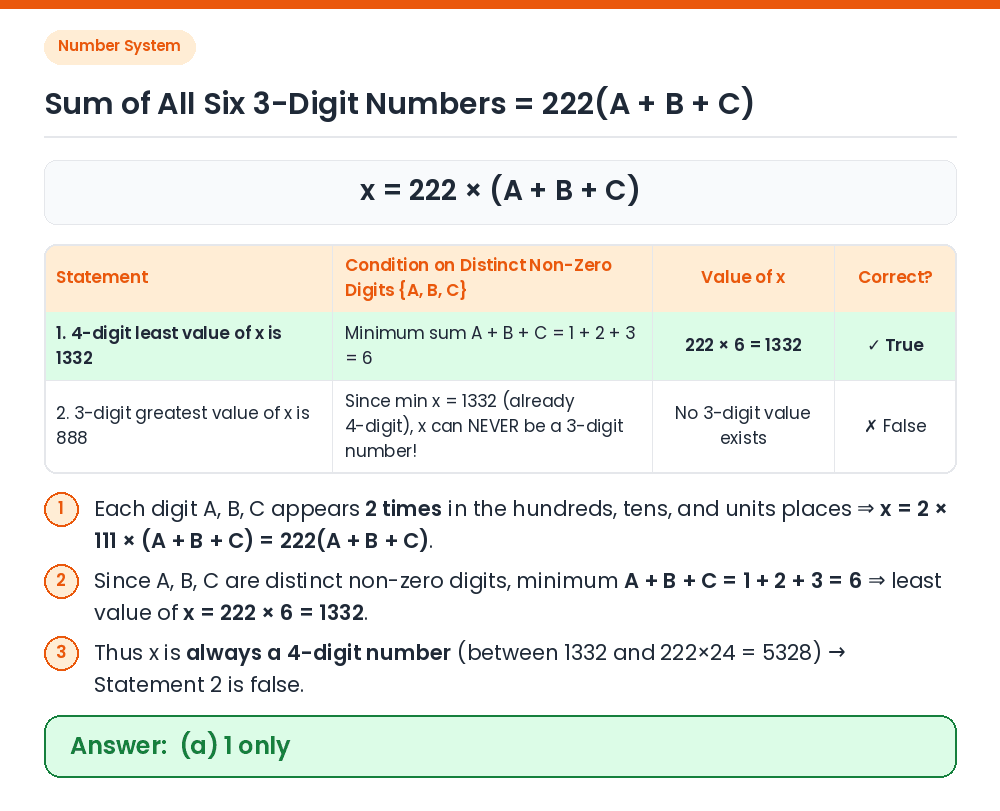
Formula for Sum x: With 3 distinct non-zero digits A, B, C, there are 3! = 6 numbers (ABC, ACB, BAC, BCA, CAB, CBA). Each digit appears twice in each place (hundreds, tens, units) ⇒ x = 2 × (100 + 10 + 1)(A + B + C) = 222(A + B + C). Check Statement 1: Since A, B, C ∈ {1, 2, ..., 9} are distinct, the minimum possible sum is A + B + C = 1 + 2 + 3 = 6 ⇒ minimum value of x = 222 × 6 = 1332 (a 4-digit number). Thus Statement 1 is correct. Check Statement 2: Since the least possible value of x is already 1332, x can never be a 3-digit number (888 would require A + B + C = 4, impossible for 3 distinct positive integers). Thus Statement 2 is incorrect. Result: Only Statement 1 is correct. Correct Answer: (a) 1 only