Civil Services Examination · Question 11
Directions: Read the following passage and answer the item that follows the passage. Your answer to this item should be based on the passage only. Passage – 1 The emissions humans put into the atmosphere now will affect the climate in the middle of the century and onwards. Technological change, meanwhile, could make a future transition away from fossil fuels cheap or it might not, leaving the world with a terrible choice between sharply reducing emissions at huge cost or suffering through the effects of unabated warming. Businesses that do not hedge against the threat of uncertain outcomes fail. The world cannot afford such recklessness on climate change. Which one of the following statements best reflects the crucial message conveyed by the author of the passage?
Show answer & explanationShow explanation
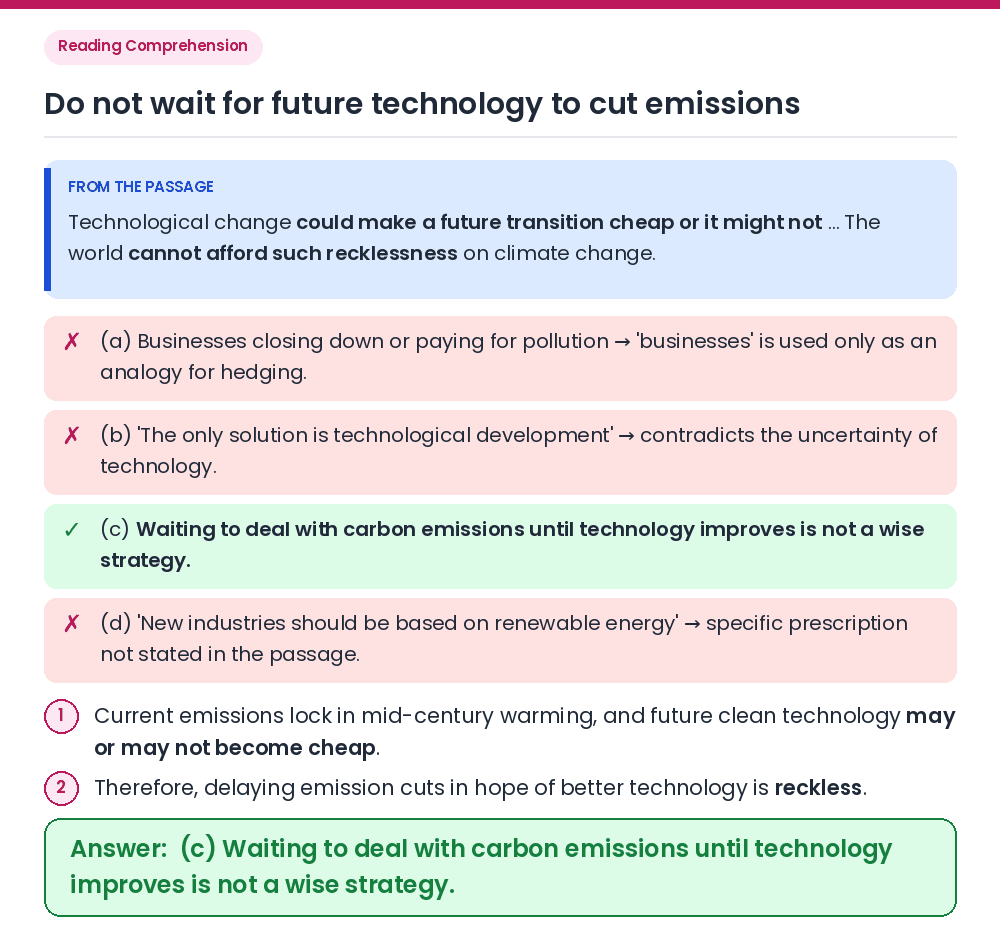
Answer: (C) Waiting to deal with carbon emissions until technology improves is not a wise strategy.
Core Idea: Today's emissions affect future climate, and future technological breakthroughs are uncertain ('could make a transition cheap or it might not'). Evaluate Option c: Relying on uncertain future technology instead of acting now is 'recklessness'; hence waiting until technology improves is unwise. Eliminate Other Options: Option (a) misreads the business analogy; (b) uses the extreme phrase 'only solution'; (d) adds a specific renewable-industry rule not in the passage. Result: Statement (c) best reflects the author's crucial message. Correct Answer: (c) Waiting to deal with carbon emissions until technology improves is not a wise strategy.