Civil Services Examination · Question 21
Directions: Read the following passage and answer the item that follows the passage. Your answer to this item should be based on the passage only. Passage – 1 To tackle the problem of pollution in cities, policy makers think that drastic actions like temporary use of odd-even number scheme for vehicles, closing schools, factories, construction activities, and banning the use of certain type of vehicles are a way forward. Even then the air is not clean. Vehicles more than 15 years old comprise one percent of the total; and taking them off the road will not make any difference. Banning certain fuels and car types arbitrarily is not proper. Diesel engines produce more PM 2.5 and less CO₂ than petrol or CNG engines. On the other hand, both diesel and CNG engines produce more NOₓ than petrol engines. No one has measured the amount of NOₓ that CNG engines are emitting. Arbitrary bans on vehicles that have passed mandated fitness tests and periodic pollution tests are unfair. What is needed is the scientific and reliable information about the source of pollutants on a continuing basis and the technologies that will work to reduce pollution from them. Which one of the following statements best reflects the most logical and rational implication conveyed by the passage?
Show answer & explanationShow explanation
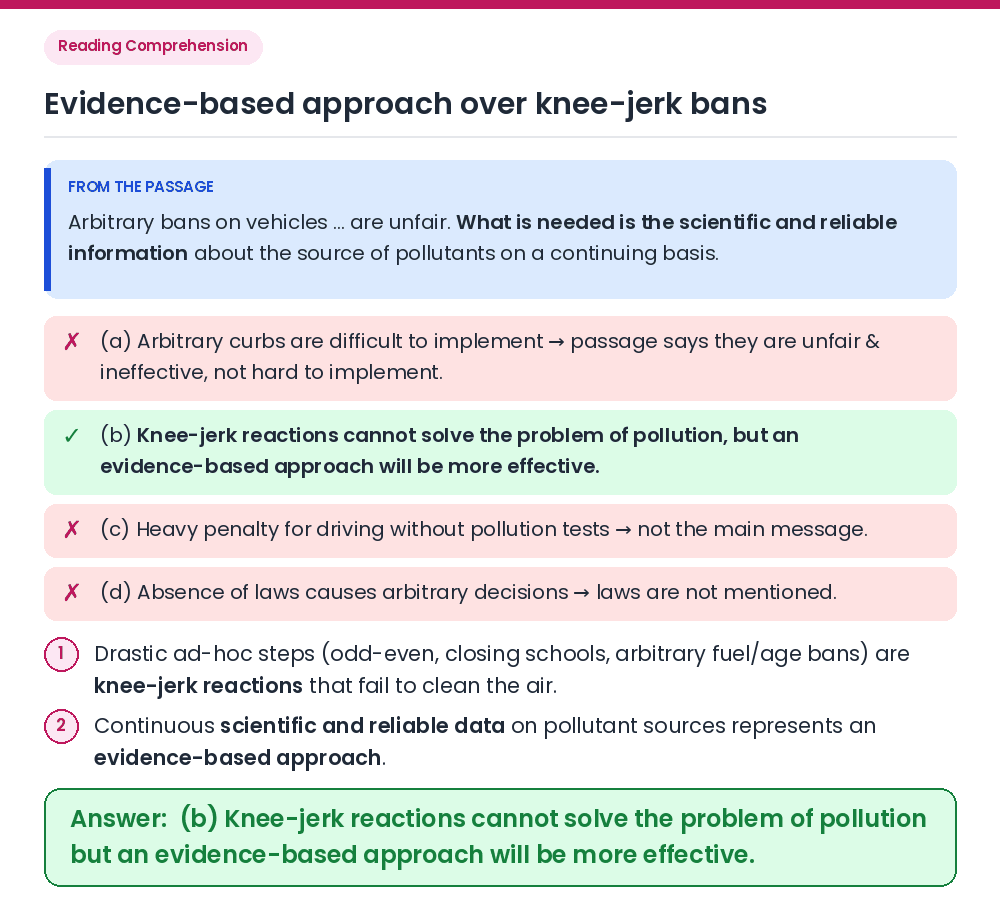
Answer: (B) Knee-jerk reactions cannot solve the problem of pollution but an evidence-based approach will be more effective.
Core Idea: The passage criticizes ad-hoc, arbitrary bans (odd-even, closing schools, banning 15-year-old vehicles) and calls for continuous scientific data and targeted technologies. Evaluate Option b: 'Knee-jerk reactions' refers to those drastic ad-hoc bans, and 'an evidence-based approach' refers to continuous scientific and reliable information. Eliminate Other Options: Difficulty of implementation (a), heavy penalties (c), and absence of laws (d) are not stated in the passage. Result: Statement (b) best reflects the logical and rational implication. Correct Answer: (b) Knee-jerk reactions cannot solve the problem of pollution but an evidence-based approach will be more effective.