Civil Services Examination · Question 46
Let pp, qq and rr be 2-digit numbers where p < q < r. If pp + qq + rr = tt0, where tt0 is a 3-digit number ending with zero, consider the following statements: 1. The number of possible values of p is 5. 2. The number of possible values of q is 6. Which of the above statements is/are correct?
Show answer & explanationShow explanation
Answer: (C) Both 1 and 2
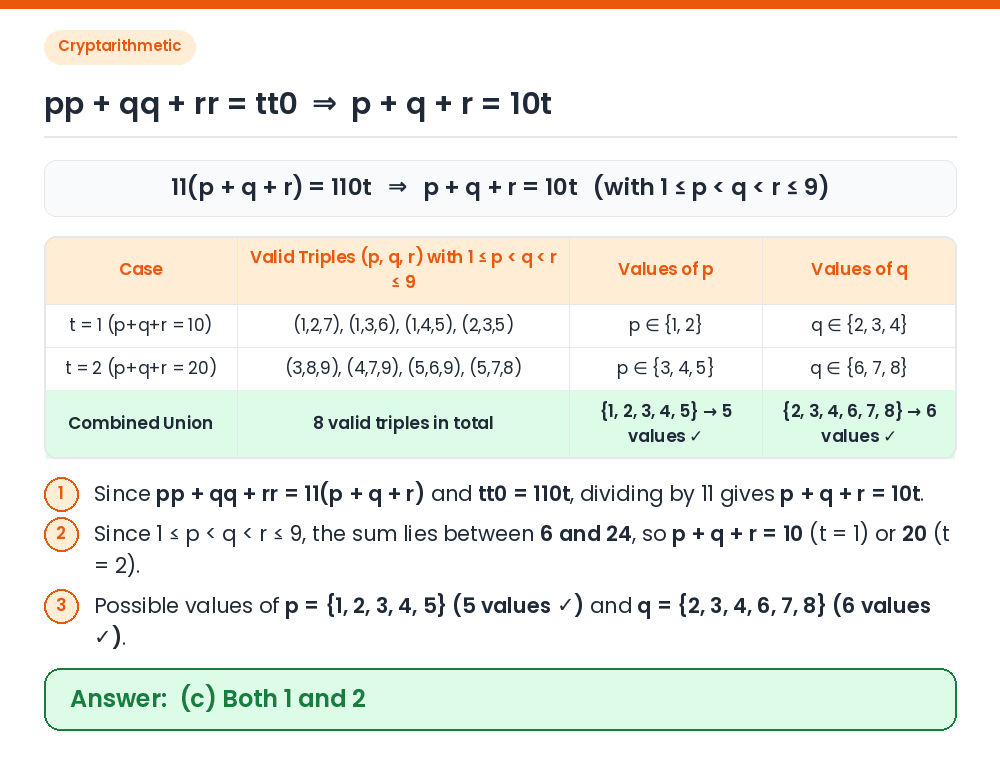
Simplify Equation: pp + qq + rr = 11(p + q + r) and tt0 = 110t ⇒ Dividing by 11 gives p + q + r = 10t. Find Possible Sums: Since 1 ≤ p < q < r ≤ 9, we have 6 ≤ p + q + r ≤ 24 ⇒ p + q + r can only be 10 (for t = 1) or 20 (for t = 2). List Triples for p + q + r = 10 and 20: • Sum = 10: (1, 2, 7), (1, 3, 6), (1, 4, 5), (2, 3, 5) • Sum = 20: (3, 8, 9), (4, 7, 9), (5, 6, 9), (5, 7, 8) Count Distinct Values & Result: • Possible values of p = {1, 2, 3, 4, 5} ⇒ 5 values (Statement 1 is correct). • Possible values of q = {2, 3, 4, 6, 7, 8} ⇒ 6 values (Statement 2 is correct). Correct Answer: (c) Both 1 and 2