Civil Services Examination · Question 63
Directions: Read the following passage and answer the item that follows the passage. Your answer to this item should be based on the passage only. Passage – 3 Pharmaceutical patents grant protection to the patentee for the duration of the patent term. The patentees enjoy the liberty to determine the prices of medicines, which is time-limited to the period of monopoly, but could be unaffordable to the public. Such patent protection offered to the patentees is believed to benefit the public over the longer term through innovations and research and development (R&D), although it comes at a cost, in the nature of higher prices for the patented medicine. The patent regime and price protection — through a legally validated high price for the medicine during the currency of the patent — provide the patentee with a legitimate mechanism to get returns on the costs incurred in innovation and research. Based on the above passage, the following assumptions have been made: 1. Patent protection given to patentees puts a huge burden on public's purchasing power in accessing patented medicines. 2. Dependence on other countries for pharmaceutical products is a huge burden for developing and poor countries. 3. Providing medicines to the public at affordable prices is a key goal during the public health policy design in many countries. 4. Governments need to find an appropriate balance between the rights of patentees and the requirements of the patients. Which of the above assumptions are valid?
Show answer & explanationShow explanation
Answer: (B) 1 and 4
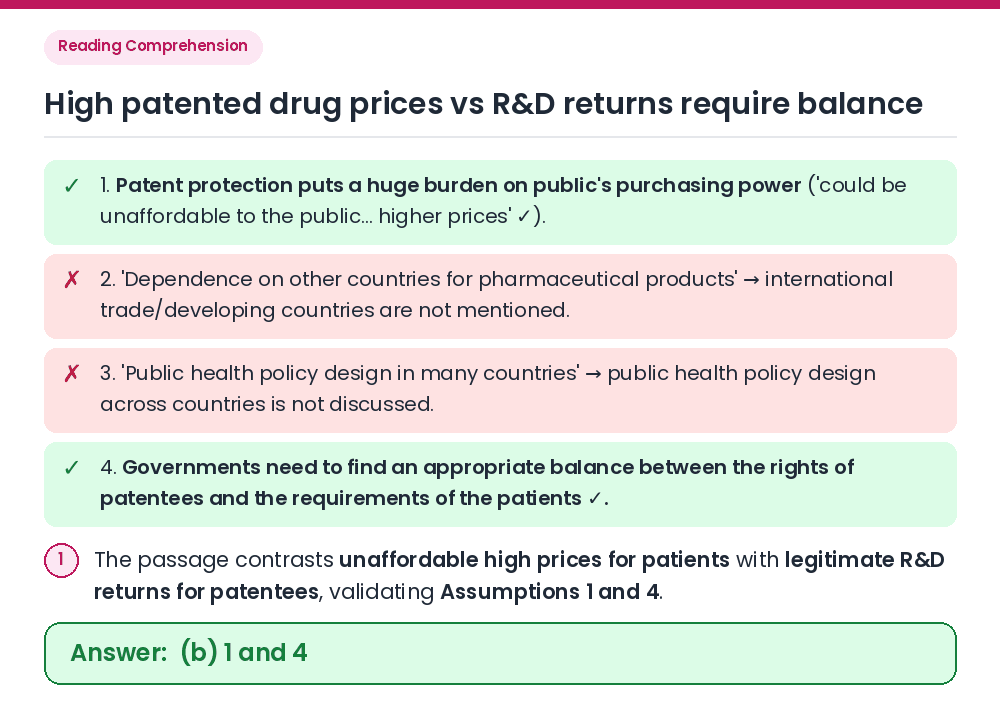
Evaluate Assumption 1: The passage explicitly states that patentees set monopoly prices that 'could be unaffordable to the public' and come at 'higher prices for the patented medicine' ⇒ Assumption 1 is valid. Evaluate Assumptions 2 & 3: Dependence of developing/poor countries on foreign imports (2) and public health policy design across many countries (3) are not mentioned in the passage ⇒ 2 and 3 are invalid. Evaluate Assumption 4: Since the passage weighs the public's affordability burden against the patentee's legitimate right to recover R&D costs, balancing the two is a core underlying assumption ⇒ Assumption 4 is valid. Result: Assumptions 1 and 4 are valid. Correct Answer: (b) 1 and 4