Civil Services Examination · Question 78
Let P, Q, R, S and T be five statements such that: I. If P is true, then both Q and S are true. II. If R and S are true, then T is false. Which of the following can be concluded? 1. If T is true, then at least one of P and R must be false. 2. If Q is true, then P is true. Select the correct answer using the code given below:
Show answer & explanationShow explanation
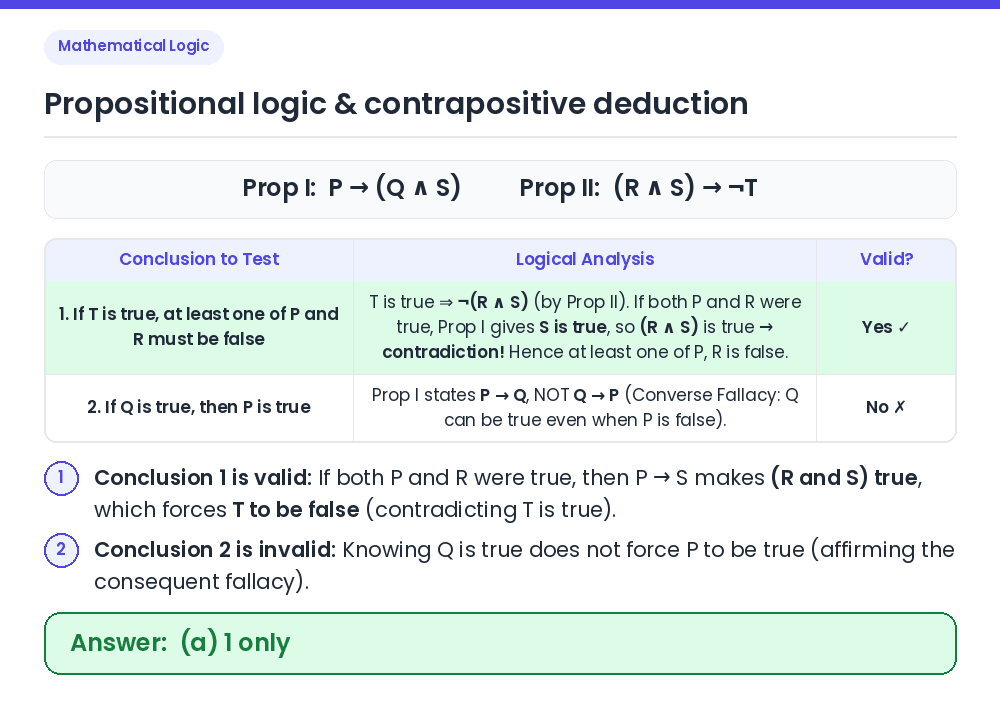
Answer: (A) 1 only
Given Propositions: (I) P → (Q ∧ S), and (II) (R ∧ S) → ¬T. Check Conclusion 1: Suppose T is true. By the contrapositive of (II), R and S cannot both be true. If P were true, (I) would make S true, which would require R to be false; and if R were true, S (and hence P) would have to be false ⇒ At least one of P and R must be false (Conclusion 1 is valid). Check Conclusion 2: From P → (Q ∧ S), Q being true does not imply that P must be true (converse fallacy) ⇒ Conclusion 2 is invalid. Result: Only Conclusion 1 can be concluded. Correct Answer: (a) 1 only