Civil Services Examination · Question 12
Passage—1 Today, if we consider cities such as New York, London and Paris as some of the most iconic cities in the world, it is because plans carrying a heavy systems approach were imposed on their precincts. The backbone of the systems theory is the process of translating social, spatial and cultural desirables into mathematical models using computing, statistics, optimization and an algorithmic way of formulating and solving problems. The early universities of the West which began to train professionals in planning, spawned some of the most ingenious planners, who were experts in these domains. This was because these very subjects were absorbed into the planning curriculum that had its roots in the social sciences, geography and architecture. Planning in India, and its education differ from the West. Based on the above passage, the following assumptions have been made : 1. India needs a new generation of urban professionals with knowledge relevant to modern urban practice. 2. Indian universities at present have no capacity or potential to impart training in systems approach. Which of the assumptions given above is/are correct?
Show answer & explanationShow explanation
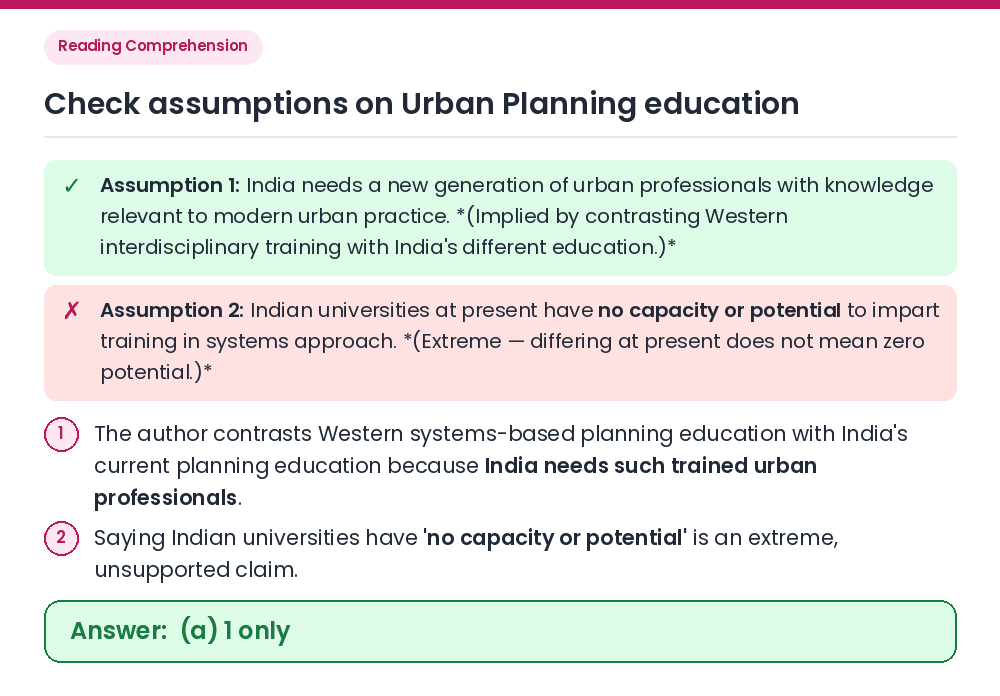
Answer: (A) 1 only
Given / Concept: An assumption must be an underlying premise of the author's comparison between Western and Indian planning education. Evaluate Assumption 1: By pointing out how Western universities trained ingenious modern planners and contrasting that with India ('Planning in India, and its education differ from the West'), the author assumes India needs professionals trained in modern urban practice ⇒ Assumption 1 is correct. Evaluate Assumption 2: Stating that Indian education 'differs' from the West does not mean Indian universities have 'no capacity or potential' ⇒ Assumption 2 is extreme and invalid. Result: Only assumption 1 is correct. Correct Answer: (a) 1 only