Civil Services Examination · Question 32
Passage—1 "The history of science is the real history of mankind." In this striking epigram, a nineteenth-century writer links science with its background. Like most epigrams, its power lies in emphasizing by contrast an aspect of truth which may be easily overlooked. In this case, it is easy to overlook the relations between science and mankind, and to treat the former as some abstract third party, which can sometimes be praised for its beneficial influences, but frequently and conveniently blamed for the horrors of war. Science and mankind cannot be divorced from time to time at men's convenience. Yet we have seen that, in spite of countless opportunities of improvement, the opening years of the present period of civilization have been dominated by international conflict. Is this the inevitable result of the progress of science or does the fault lie elsewhere? Based on the above passage, the following assumptions have been made : 1. The horrors of modern life are the inevitable result of the progress of science. 2. The aspect of truth likely to be overlooked is that science is what man has made it. Which of the assumptions given above is/are correct?
Show answer & explanationShow explanation
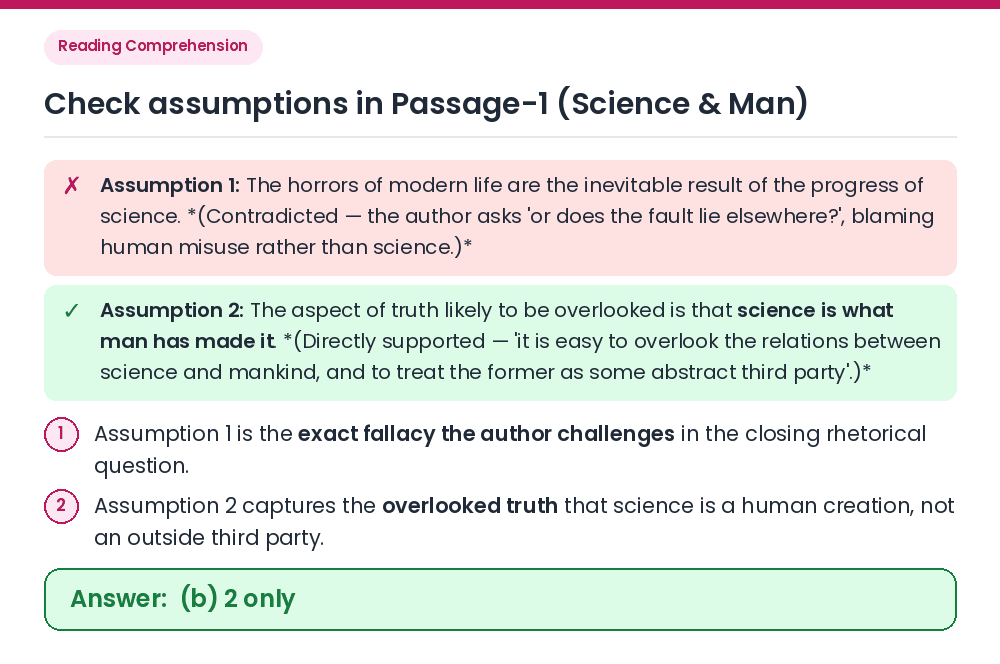
Answer: (B) 2 only
Given / Concept: Identify which statement reflects the author's underlying premise about science and mankind. Evaluate Assumption 1: The passage ends with the rhetorical question: 'Is this the inevitable result of the progress of science or does the fault lie elsewhere?' — implying the fault lies with human actions, NOT inevitably with science ⇒ Assumption 1 is false. Evaluate Assumption 2: The passage states it is easy to overlook 'the relations between science and mankind, and to treat the former as some abstract third party' — meaning science is shaped by man ⇒ Assumption 2 is correct. Result: Only assumption 2 is correct. Correct Answer: (b) 2 only