Civil Services Examination · Question 42
Passage—1 Conventional classrooms, by emphasizing fixed duration over learning effectiveness, resign themselves to variable outcomes. The tyranny of the classroom is that every learner is subjected to the same set of lectures in the same way for the same duration. In the end, a few learners shine, some survive, and the rest are left behind. After the fixed duration, the classroom model moves on, with not a thought spared for those left behind. This is how we end up with 10 percent employability in our graduates after a decade and half of formal education. Repeating the same ineffectual script in the realm of skill education will not produce different results. Based on the above passage, the following assumptions have been made : 1. As a large number of workers in our country are employed in unorganized sector, India does not need to change its present conventional classroom system of education. 2. Even with its present conventional classroom system of education, India produces sufficient number of skilled workers to fully realize the benefits of demographic dividend. Which of the assumptions given above is/are valid?
Show answer & explanationShow explanation
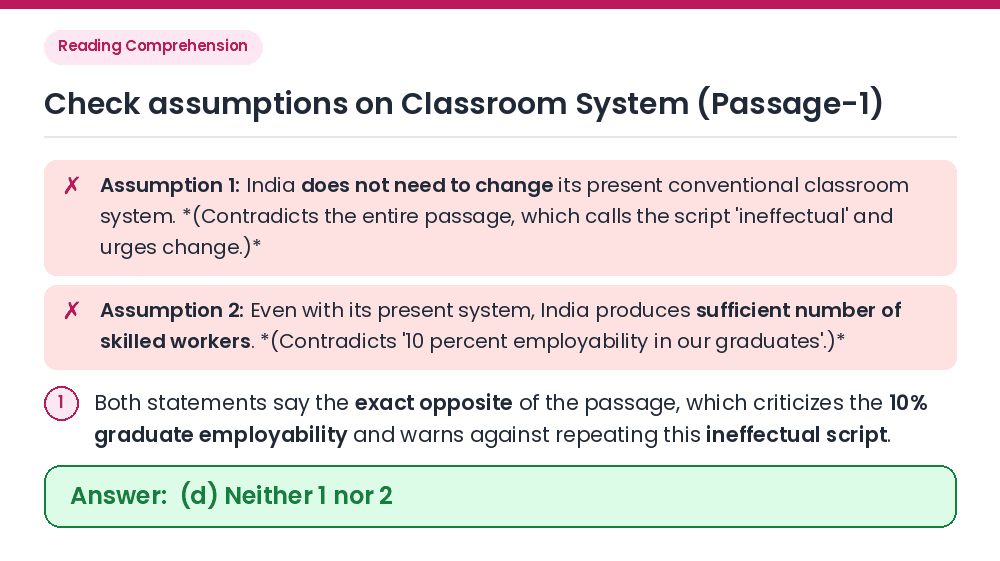
Answer: (D) Neither 1 nor 2
Given / Concept: Check whether the passage supports keeping the conventional classroom system or claims it produces enough skilled workers. Evaluate Assumption 1: The passage criticizes the conventional classroom model as an 'ineffectual script' and warns against repeating it in skill education ⇒ saying India does not need to change it is false (Assumption 1 is invalid). Evaluate Assumption 2: The passage explicitly laments that we end up with only '10 percent employability in our graduates' ⇒ claiming India produces sufficient skilled workers contradicts the text (Assumption 2 is invalid). Result: Neither assumption 1 nor 2 is valid. Correct Answer: (d) Neither 1 nor 2