Civil Services Examination · Question 55
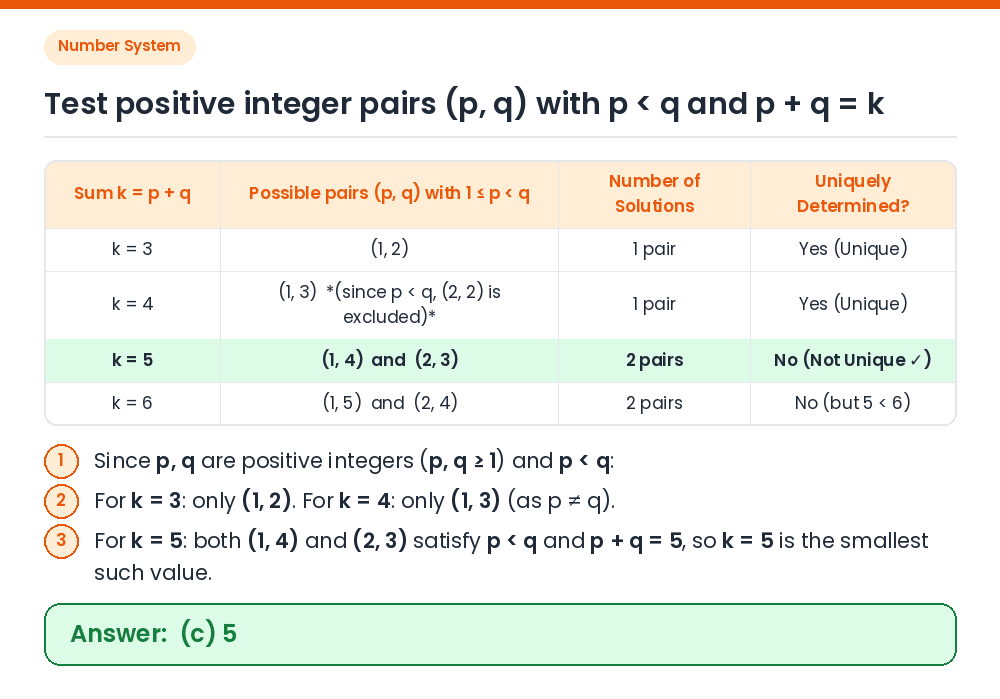
Let p and q be positive integers satisfying p < q and p + q = k. What is the smallest value of k that does not determine p and q uniquely?
Show answer & explanationShow explanation
Answer: (C) 5
Given / Concept: p and q are positive integers (1 ≤ p < q) with p + q = k. We want the smallest k that has at least two distinct valid pairs (p, q). Test k = 3 and k = 4: ⇒ For k = 3: 1 + 2 = 3 → only one pair (1, 2) (unique). ⇒ For k = 4: 1 + 3 = 4 → only one pair (1, 3), since p < q rules out (2, 2) (unique). Test k = 5: ⇒ For k = 5: 1 + 4 = 5 and 2 + 3 = 5 → two valid pairs (1, 4) and (2, 3)! Result: The smallest value of k that does not determine p and q uniquely is 5. Correct Answer: (c) 5