Civil Services Examination · Question 12
Read the following passage and answer the items that follow the passage. Your answers to these items should be based on the passage only. Passage – 1 Each State in India faces a distinctive set of challenges regarding the impact of warming, but also offers its own set of opportunities for reducing emissions depending on its natural resources. For example, coastal States need to take action to protect their shores from sea level rise, districts that are drier need to prepare for variable monsoon precipitation. Himalayan regions have their own unique challenges, and selected parts of peninsular India and offshore areas offer great opportunities for harnessing wind power. These various aspects need to be considered for developing clear and sustainable goals for the future. With reference to the passage, the following assumptions have been made : I. Green energy production can be linked to/integrated with the climate change mitigation and adaptation strategies. II. Effects of climate change are much more severe in coastal and mountainous regions. Which of the above assumptions is/are valid ?
Show answer & explanationShow explanation
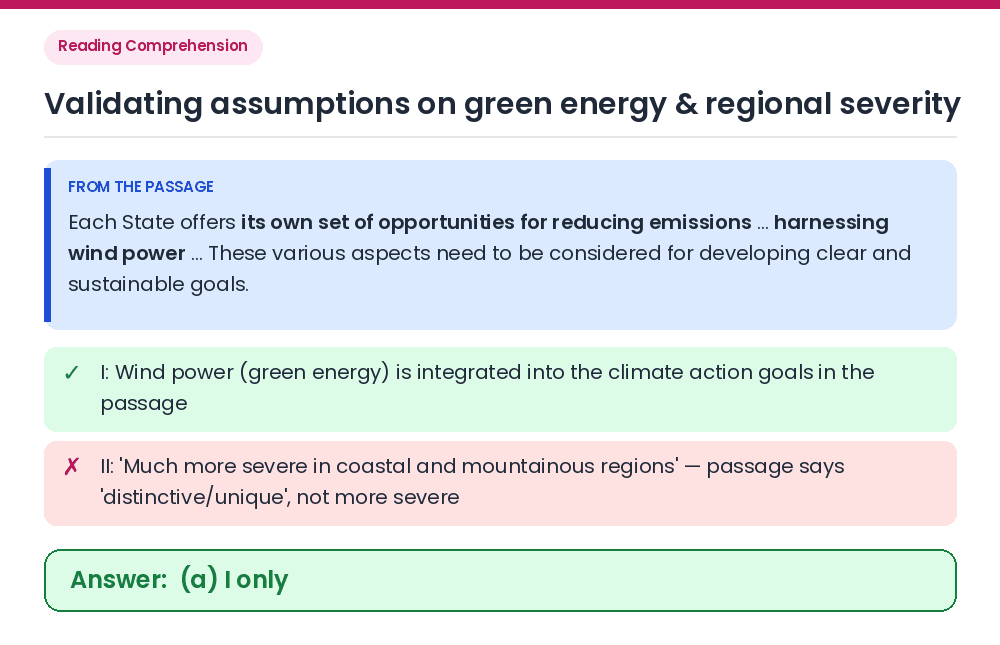
Answer: (A) I only
Concept: Check whether each statement is assumed by the author in Passage 1. Check Statement I: The passage links regional adaptation challenges (sea-level rise, variable monsoon) with emission-reduction opportunities like harnessing wind power in peninsular/offshore India to build sustainable goals. Hence I is valid. Check Statement II: The passage says each region has 'distinctive' or 'unique' challenges (coastal, drier districts, Himalayan); it never compares severity to say coastal/mountainous regions are 'much more severe'. Hence II is invalid. Result: Only assumption I is valid. Correct Answer: (a) I only