Civil Services Examination · Question 31
Read the following passage and answer the items that follow the passage. Your answers to these items should be based on the passage only. Passage – 1 In our country, regrettably, teaching and learning for the examination have been our forte but the new demands of society and the future of work require critical and independent thinking, learning through doing, asking questions from multiple disciplinary perspectives on the same issue, using evidence for building arguments, and reflecting and articulation. Higher education should not “either be a mere servant of the government policy or a passive respondent to public mood.” Higher learning is all about how to think rather than what to think. Teaching has to be re-invented. Which one of the following statements best reflects the central idea conveyed by the passage ?
Show answer & explanationShow explanation
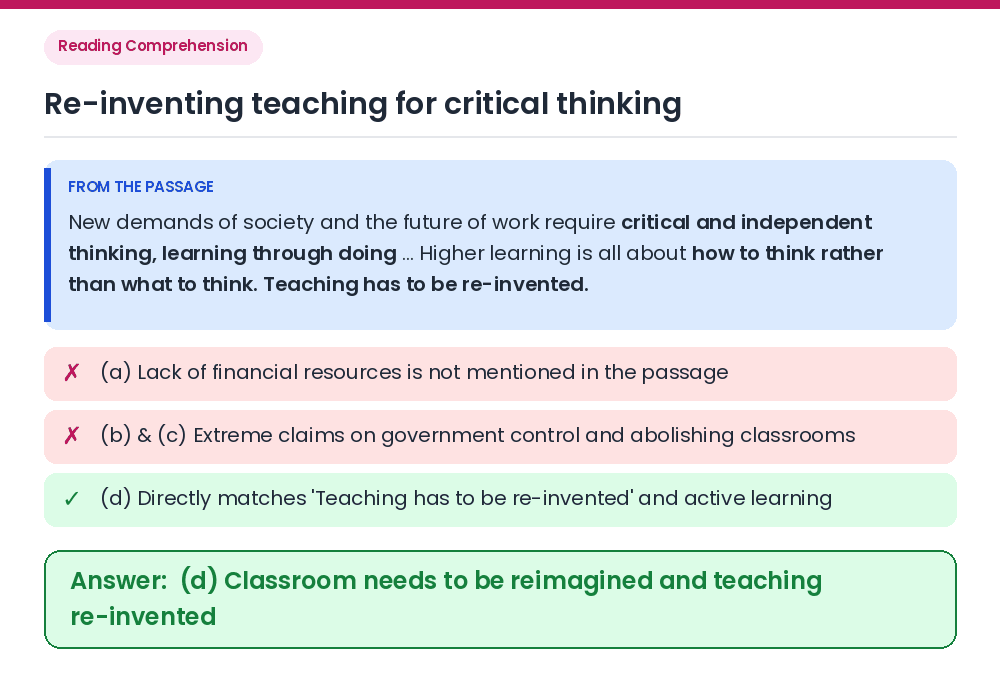
Answer: (D) Classroom needs to be reimagined and teaching needs to be re-invented.
Concept: Identify the main takeaway of Passage 1 on shifting higher education from exam-oriented rote learning to critical thinking. Passage Analysis: The passage emphasizes learning through doing, critical thinking, and 'how to think rather than what to think', concluding explicitly that 'Teaching has to be re-invented.' Elimination: Resource shortage (a), removing government control (b), and abolishing classrooms altogether (c) are not advocated in the passage. Result: Classroom needs to be reimagined and teaching needs to be re-invented. Correct Answer: (d) Classroom needs to be reimagined and teaching needs to be re-invented.