Civil Services Examination · Question 4
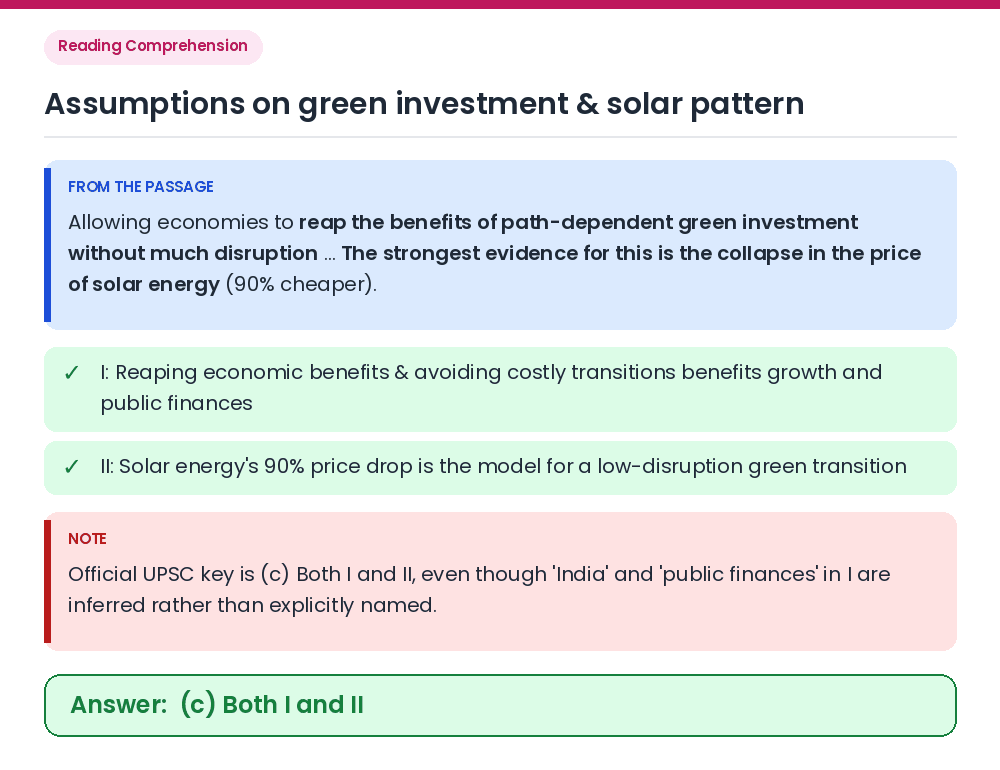
Read the following passage and answer the items that follow the passage. Your answers to these items should be based on the passage only. Passage – 2 The history of renewable energy suggests there is a steep learning curve, meaning that, as more is produced, costs fall rapidly because of economies of scale and learning by doing. The firms' green innovation is path-dependent : the more a firm does, the more it is likely to do in the future. The strongest evidence for this is the collapse in the price of solar energy, which became about 90% cheaper during the 2010s, repeatedly beating forecasts. Moving early and gradually gives economies more time to adjust, allowing them to reap the benefits of path-dependent green investment without much disruption. A late, more chaotic transition is costlier. With reference to the above passage, the following assumptions have been made : I. Path-dependent green investments will eventually most likely benefit growth as well as public finances in a country like India. II. If other green technologies follow the same pattern as that of solar energy, there will most likely be an easy green transition. Which of the above assumptions is/are valid ?
Show answer & explanationShow explanation
Answer: (C) Both I and II
Concept: Evaluate the underlying assumptions behind the author's argument for early, path-dependent green investment. Check Statement I: The passage states that early path-dependent green investment allows economies to reap benefits and avoid costlier late transitions, implying benefits for economic growth and public finances in developing economies like India. (Note: Although 'India' and 'public finances' are not explicitly named in the text, the official UPSC key accepts Statement I as a valid application of the passage's premise.) Check Statement II: Solar energy is cited as 'the strongest evidence' of a 90% cost collapse via the learning curve; thus, if other green technologies follow the solar pattern, a smooth/easy transition without much disruption is expected. Result: Both assumptions I and II are valid as per the official answer key. Correct Answer: (c) Both I and II