Civil Services Examination · Question 42
Which of the following statements with regard to Large Language Models (LLMs) used in machine learning is/are correct ? 1. LLMs assign probabilities to the next possible words and then pick the one with the highest probability. 2. LLMs process data through mathematical optimization to minimise prediction errors. 3. LLMs produce unbiased outputs. Select the answer using the code given below :
Show answer & explanationShow explanation
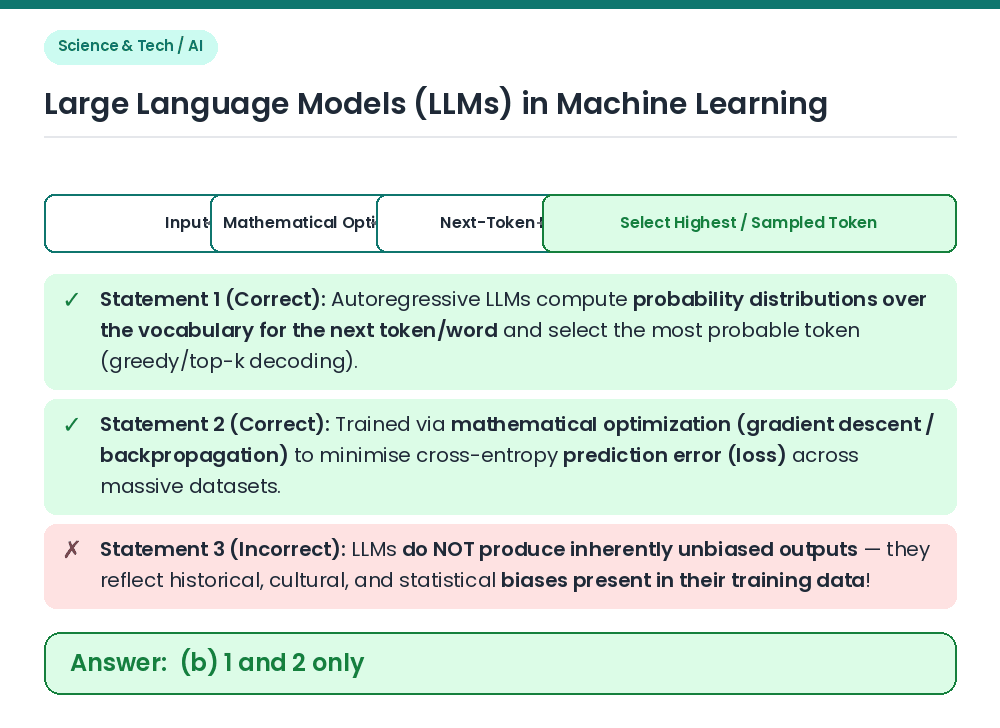
Answer: (B) 1 and 2 only
Concept: Large Language Models (LLMs) are deep neural networks built on the Transformer architecture (introduced in 2017) trained on vast text corpora. Evaluate Statements 1 & 2: ⇒ At inference time, an LLM operates as a next-token predictor that assigns a probability score (via a softmax layer) to every possible next word/token and picks the highest-probability candidate (Statement 1 is correct); and during training, billions of weights are adjusted through mathematical optimization (stochastic gradient descent / Adam optimizer) to minimise prediction error (loss function) (Statement 2 is correct). Evaluate Statement 3: ⇒ Because LLMs learn statistical patterns from human-generated internet text, they frequently inherit and amplify societal, gender, and representational biases (and can also 'hallucinate'), so they do NOT inherently produce unbiased outputs (Statement 3 is incorrect). Result: Statements 1 and 2 only are correct. Related Facts: Key Concepts in LLMs: • Transformer Architecture: Uses 'Self-Attention' mechanisms ('Attention Is All You Need', 2017) to weigh relationships between all tokens in a sequence simultaneously. • Alignment & Guardrails: Techniques like RLHF (Reinforcement Learning from Human Feedback) are used post-training to reduce bias and harmful outputs. Correct Answer: (b) 1 and 2 only