Civil Services Examination · Question 62
Which of the following statements about a Zero First Information Report (Zero FIR) under the Bharatiya Nagarik Suraksha Sanhita (BNSS), 2023 is/are correct ? 1. A Zero FIR can be lodged at a police station, even though the place of commission of a cognizable/non-cognizable offence is outside the territorial jurisdiction of that police station. 2. The Officer-in-Charge of the police station where a Zero FIR has been lodged may, with the permission of the competent authority, initiate a preliminary enquiry. 3. Under Zero FIR, it is obligatory for the informant to furnish information electronically. Select the answer using the code given below :
Show answer & explanationShow explanation
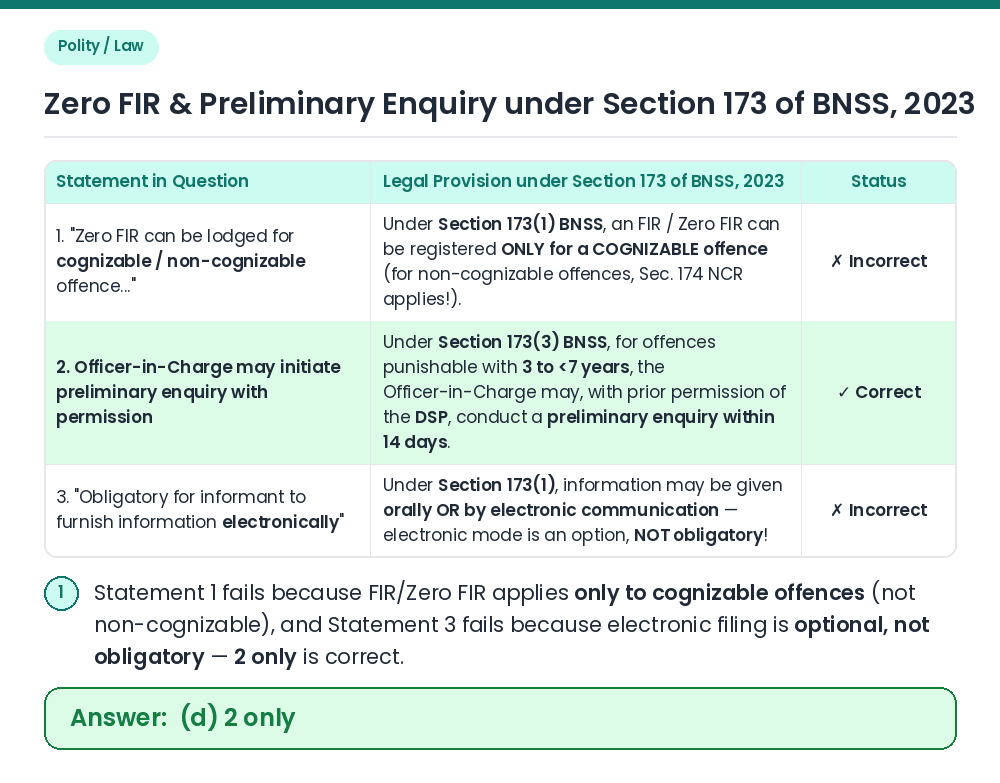
Answer: (D) 2 only
Concept: Section 173 of the Bharatiya Nagarik Suraksha Sanhita (BNSS), 2023 (replacing Section 154 of the CrPC, 1973) codifies Zero FIR, e-FIR, and preliminary enquiry. Evaluate Statement 1 — Cognizable vs Non-Cognizable Trap: ⇒ Section 173(1) of BNSS explicitly states: 'Every information relating to the commission of a COGNIZABLE offence, irrespective of the area where the offence is committed, may be given...' — an FIR or Zero FIR is registered ONLY for cognizable offences (non-cognizable offences are recorded in the Non-Cognizable Register under Section 174 BNSS) — Statement 1 is incorrect. Evaluate Statements 2 & 3: ⇒ Under Section 173(3) of BNSS, for offences punishable with 3 years or more but less than 7 years, the Officer-in-Charge of the police station may, with the prior permission of an officer not below the rank of Deputy Superintendent of Police (DSP), proceed to conduct a preliminary enquiry within 14 days (Statement 2 is correct); and under Section 173(1), information may be given 'orally or by electronic communication' (if electronic, signed within 3 days) — so electronic mode is optional, NOT obligatory (Statement 3 is incorrect). Result: Only statement 2 is correct. Related Facts: Key BNSS Reforms under Section 173: • Origin of Zero FIR: First recommended by the Justice J.S. Verma Committee (2013) after the Nirbhaya case and now statutorily codified in Section 173(1) of BNSS. • Remedy on Refusal (Section 173(4)): If the Officer-in-Charge refuses to record an FIR, the aggrieved person may send the substance to the Superintendent of Police (SP) or file an application before the Magistrate. Correct Answer: (d) 2 only